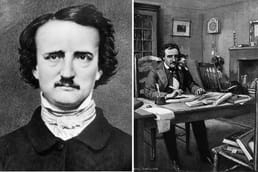
Rain was falling in Baltimore on October 3, 1849, when Joseph W. Walker came upon a man in shabby secondhand clothes at Ryan’s 4th Ward polls. The man was in distress, and Walker recognized him as Edgar Allan Poe. He wrote at once to Dr. Joseph E. Snodgrass, saying the gentleman “goes under the cognomen of Edgar A. Poe” and needed immediate assistance.[4]
Edgar Allan Poe disappeared after leaving Richmond on September 27, 1849, and reappeared six days later in Baltimore, delirious, wearing clothes that were not his own, and unable to explain where he had been. He died on October 7, leaving one of American literature’s strangest death mysteries unresolved.
Poe had left Richmond with an ordinary itinerary and an extraordinary amount at stake. He had rekindled a relationship with Sarah Elmira Royster Shelton, an old sweetheart who was now a widow, and the two had become engaged despite her children’s disapproval.[3] His plan was to travel to Philadelphia for an editing job, then continue to New York to bring his aunt and mother-in-law, Maria Clemm, back to Richmond for the wedding.[3]
The night before he traveled, Shelton later wrote, Poe was “very sad” and “quite sick,” with a fever and weak pulse. A local doctor reportedly advised him not to go, but Poe boarded a steamer from Richmond at 4 a.m. on September 27, bound for Baltimore.[3]
The Lost Week
After Poe reached Baltimore on September 28, the record goes dark. Where he went, whom he saw, and what happened over the next five days have never been determined.[5] He never arrived in Philadelphia for the editing work. He never made it to New York for Maria Clemm. The next reliable trace is Walker’s October 3 note from Ryan’s Tavern, also known as Gunner’s Hall, which was serving as a polling place.[4]
The polling place matters because one long-standing theory involves “cooping,” a 19th-century form of election fraud in which men were seized, disguised, sometimes beaten or drugged, and forced to vote repeatedly for a political faction.[2] The theory fits the location and the strange clothes, but it has never been proved.[5]
The same thin set of facts has invited a crowded list of explanations. Poe’s death has been attributed, at various times, to alcohol, withdrawal, murder, suicide, cholera, hypoglycemia, rabies, syphilis, tuberculosis, influenza, a brain tumor, carbon monoxide poisoning, or a beating.[2][4] The alcohol explanation, long treated as obvious, remains disputed, and much of the surviving account depends on witnesses whose reliability has been questioned.[2]
Four Days in the Hospital
Snodgrass came to the scene with Poe’s uncle, Henry Herring. After an attempt to secure a private room where Poe could recover, Herring persuaded Snodgrass that Poe needed medical care, and Poe was taken to Washington University Hospital on Broadway Street.[5] He had no visitors there and never gave a coherent account of how he had ended up in that condition.[2]
His attending physician, John J. Moran, later became one of the main sources for Poe’s final days, though historians have warned that Moran’s versions changed and are not fully reliable.[2] One detail from Moran’s account endured anyway. The night before Poe died, Moran said, the writer repeatedly called out the name “Reynolds,” a person or reference that remains unidentified.[4]
Poe died on October 7, 1849, at age 40.[2] His funeral was small, with only about 10 mourners present, and he was buried at the First Presbyterian Church Burying Ground in Baltimore.[5] In 1875, his remains were moved to a larger monument, which now also marks the burial places of his wife, Virginia, and Maria Clemm.[2]
One more injury followed him. Rufus Wilmot Griswold, Poe’s rival and later literary executor, wrote an obituary under the name “Ludwig” and produced a biography that portrayed Poe as depraved, drunken, and drug-addled. Friends denounced the portrait, and much of Griswold’s evidence is believed to have been fabricated, but the image stuck for generations.[2]
Strip away the legend and the scene is still unsettling: a sick man leaving Richmond before dawn, five unaccounted days in Baltimore, an election-day tavern, clothes that did not belong to him, and Walker’s urgent note sent through the rain.
Sources
- HISTORY, “The Riddle of Edgar Allan Poe’s Death”
- Wikipedia, “Death of Edgar Allan Poe”
- History Uncovered, “Inside Edgar Allan Poe's Mysterious Death”
- Smithsonian Magazine, “The (Still) Mysterious Death of Edgar Allan Poe”
- Catalyst Magazine, “Rooted in History: 175 Years Later, Mystery Still Shrouds Poe’s Death”