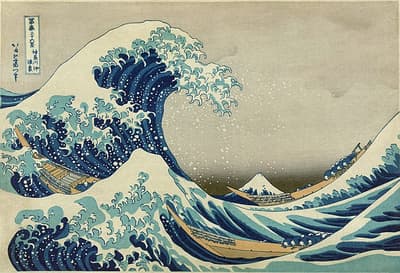
A tiny Mount Fuji sits almost unnoticed beneath the curl of the wave. In the image most people call The Great Wave, the eye goes first to the clawed foam, then to the boats, then to the blue wall of water. Only after that does the mountain appear, small and still in the distance.[1]
Hokusai’s famous Great Wave is not a standalone painting. It is a woodblock print from Thirty-six Views of Mount Fuji, a landscape series showing the mountain from different places, seasons, and weather, later expanded to 46 prints after its success.
Katsushika Hokusai made the series around 1830 to 1832, when he was in his seventies and at a late peak in his career.[1] The publisher was Nishimura Yohachi, and the subject, print after print, was Mount Fuji, seen from near and far, under clear skies, storms, and changing conditions.[1] The wave became the celebrity, but the mountain was the assignment.
The print’s full title helps restore the scene: Under the Wave off Kanagawa, or Kanagawa-oki Nami Ura.[2] It shows three boats moving through a storm-tossed sea, with a huge cresting wave forming over them and Mount Fuji in the background.[2] The Art Institute of Chicago describes Fuji as the protagonist of the whole series, appearing in each scene from different directions and distances.[3] In this one, the mountain is almost a visual whisper, tucked beneath the foam.
The Mountain Hiding Inside the Wave
In Hokusai’s most famous image, Fuji seems at first to be the least dramatic thing on the paper. The wave is enormous. The boats are fragile. The foam reaches like fingers. The mountain, by contrast, is a calm triangular form far away, centered low beneath the breaking water.[2] Fuji does not need to dominate the scene to organize it.
The series was called Fugaku Sanjūrokkei, or Thirty-six Views of Mount Fuji.[1] The title was accurate at first. Hokusai began with 36 landscape prints, but the publication succeeded quickly enough that 10 more were added, making 46 views in all.[1] Modern viewers often know the first print and miss the larger project, a sustained act of looking at one mountain from many angles.
Several of those angles became famous in their own right. The series includes The Great Wave off Kanagawa, Fine Wind, Clear Morning, and Thunderstorm Beneath the Summit.[1] Another print, Kajikazawa in Kai Province, is less famous but has been regarded as one of the set’s finest works.[1] The Art Institute notes that the series helped establish the popularity of landscape prints, an appeal that has lasted well beyond Hokusai’s lifetime.[3]
A Print Made to Travel
The image is often casually called a painting, but it is a color woodblock print.[2] Hokusai’s drawing was glued to a woodblock to guide the carving, which meant the original drawing was lost in the process.[1] Inked blocks were then pressed onto paper, and complex images required separate blocks for different colors.[1] The finished work was not one unique canvas, but an image that could exist in multiple impressions.
Color helped the wave travel, too. The series is noted for its copious use of Prussian blue, also known as Berlin blue, a pigment that had become newly affordable and appears in many of Hokusai’s skies and waters.[3] In The Great Wave, that blue makes the sea feel cold, graphic, and startlingly modern. The print’s use of Prussian blue helped revolutionize Japanese prints.[2]
Hokusai’s mountain series found immediate success in Japan and later in Europe, where his art influenced Impressionist artists.[2] Today, copies of The Great Wave are held by museums around the world.[2] Its fame can make the image feel detached from its own series, as if the wave broke free and kept traveling alone.
Look again, though, and the original structure returns. The boats lean into danger. The wave curls above them. Far behind the spray, Mount Fuji waits in the center distance, small enough to miss, steady enough to anchor the storm.