In the paperwork, the toy company kept pointing at claws. The figures looked enough like people to stand upright in a child's hand, but Toy Biz had a stranger job than selling make-believe. It had to persuade the United States Court of International Trade that some of its plastic heroes, including X-Men, Spider-Man, and Fantastic Four characters, did not clearly represent human beings.[1]
In 2003, Toy Biz won a tariff fight by arguing that many Marvel action figures were toys representing non-human creatures, not dolls representing people. The old tariff categories mattered because dolls could be taxed more heavily than certain other toys.
The boxes had come in through Seattle and Los Angeles in 1994, packed with action figures on colorful cardboard backings and, in some cases, small weapons or equipment.[1] Customs treated them as dolls, the category for figures representing human beings, and applied a 12 percent import duty. Toy Biz wanted them under a different line: toys representing animals or other non-human creatures, a category taxed at 6.8 percent.[1]
Toy Biz's lawyers aimed at one phrase in the tariff schedule. A doll, they argued, had to represent only a human being. The company pointed to tentacles, claws, wings, and other odd pieces of superhero anatomy, then asked the court to see those bodies the way a tariff book did: as creatures that could not be neatly filed with ordinary people.[1]
Judge Judith Barzilay held the blister pack up to the tariff schedule, not to comic book theology. Under the Harmonized Tariff Schedule, she wrote, a doll had to clearly represent a human being. The action figures at issue were not dolls because of the non-human characteristics they displayed.[1]
The case had stretched over several opinions before the final ruling. Toy Biz did not win every character every time. A legal commentary later noted that Silver Samurai was treated as a doll in an earlier stage, while the final 2003 opinion left an item called Jumpsie in the doll category.[2] The law was not reading comic lore so much as measuring plastic bodies against a customs form.
The court also noted that the fight was already becoming a museum piece. By 2002, the doll and other-toy provisions had moved to the same duty-free rate, making the dispute mostly retrospective.[1] That helps explain why the case keeps traveling online. It survived less as a tax precedent than as a tiny public record of bureaucracy making fantasy literal. Slate later described the odd result as trade policy costing the X-Men their humanity.[3]
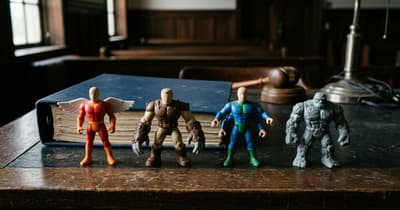
Look back at the little figures on the table and the joke gets smaller, not larger. No judge needed to believe in mutants. No customs officer needed to read a comic. The system only needed a box to check, and for a moment the cheapest box was the one marked creature.