Jake had two years left before college, so he did what any reasonable teenager facing a deadline would do: he emailed his friends the rulebooks for The Campaign for North Africa. Then they sat down in a family dining room and began a board game that, at ordinary weekend speed, could still be going when they were old enough to have children of their own.[1]
The Campaign for North Africa is a 1978 World War II board wargame famous for its 1,500 hour playtime, ten recommended players, and a logistics rule that makes Italian troops need extra water to boil pasta.
Simulations Publications, Inc. put the box on sale in 1978, promising a simulation of the desert war in Libya and Egypt from 1940 through early 1943. Wargame Academy describes it as the most logistically oriented game ever designed, built for sophisticated wargamers and serious students of history rather than casual players looking for a fast victory.[2]
A full campaign covers 111 turns, each standing for one week of war. The recommended setup splits ten people into two teams, with jobs that sound less like game-night roles than a headquarters staff: commander in chief, logistics commander, rear area commander, air commander, and front line commander.[3] One person does not simply move tanks. Someone else has to keep the tanks alive.
The famous pasta rule sits there like a tiny joke that somehow swallowed the table. Kotaku describes Italian forces needing an extra water ration so their pasta can be boiled; troops denied that ration can become disorganized in the field.[1] The joke lands because it is also the point. The game turns romance about desert warfare into paperwork, thirst, fuel, timing, storage, and the humiliation of being stopped by dinner.
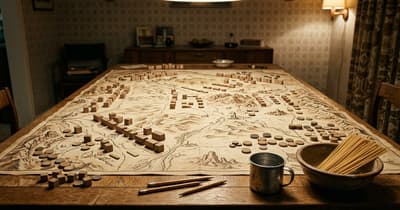
The maps stretch to roughly 9.5 feet when laid together, with thousands of counters, multiple rule and chart booklets, and enough tables to make a dining room feel borrowed from an army office.[3] Wargame Academy's description is almost tender about the burden: very little has been abstracted, and the players must digest and coordinate a ferocious amount of information.[2]
Kotaku found players gathering around the game anyway, including Jake and his friends, pulled by the scale of an attempt its own designer did not fully expect people to finish.[1] A normal board game lets people pretend war can be decided by nerve and clever moves. This one makes them appoint a quartermaster and ask whether the pasta water arrived.
On Jake's table, a ration chit, a supply column, and a few extra units of water for noodles turned cardboard soldiers back into hungry bodies. The game is funny because it gives pasta the gravity of artillery. Its final image is a dining room quartermaster leaning over the map, making sure the army has enough water to eat.