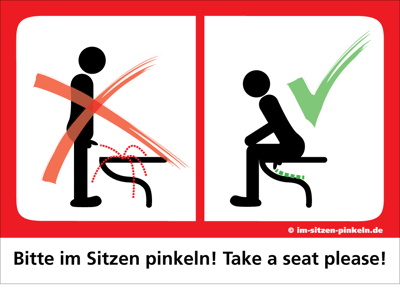
In some German bathrooms, the warning is waiting above the toilet: a stick figure standing to urinate, a red circle around him, a slash through the act. Lift the seat in the wrong place and a little device called a WC-Geist, or toilet ghost, can even tell you to sit down.[3]
German men are often encouraged to pee sitting down, especially at home and in shared bathrooms, because standing can spray urine onto the rim, floor, walls, and nearby surfaces. The habit is called Sitzpinkeln, and the man who does it is a Sitzpinkler.
Roommates, café owners, and mothers have been known to post reminders over toilets telling men that standing is forbidden, or at least strongly discouraged.[1] For visitors, especially men from countries where standing feels automatic, the message can land like a strange little referendum on masculinity.
The German word carries more than plumbing advice. Sitzpinkeln refers to sitting while peeing, and Sitzpinkler means a man who does it.[3] The term can also be used as an insult, suggesting unmasculine behavior, roughly in the territory of “wuss.”[3] A bathroom habit, somehow, becomes a character assessment.
Andrew Bulkeley, writing from Berlin, describes the expatriate reaction with comic despair. Foreign men see a crossed-out standing urinator and feel accused. He admits that when he was younger in Germany, those signs sometimes provoked quiet acts of rebellion. He would stand anyway, then look down and see what the sign had been warning about: splashes on the lip of the toilet, the lid, and sometimes the floor.[1]
The Splash Is the Point
A German life blog aimed at newcomers puts the case bluntly: when a man pees standing up, small droplets can splash around the toilet, onto the wall, or onto the floor. If nobody cleans them, they can accumulate into stains and smell.[2]
That is why the custom is especially common in homes and shared flats, where the person who makes the mess may not be the person who later cleans the bathroom.[2] The etiquette is less about anatomy than housekeeping. Sitting lowers the distance and spares everyone the forensic question of whose invisible droplets are drying near the baseboards.
Bulkeley adds a particularly German piece of porcelain to the story: the platform toilet. Some German households still have toilets with a dry shelf, rather than the deeper water bowl common elsewhere.[1] His theory is simple. A stream hitting a flat dry surface sprays back and outward, the way water poured onto a flat surface shoots in more than one direction.[1] In that bathroom, a proud stance can create a very unproud cleanup.
A Court Case for Standing
Not every German man accepts the sitting rule. In 2015, a court in Düsseldorf ruled in favor of a man’s right to urinate standing up after his landlord sought compensation for urine damage to a marble bathroom floor.[3] The case sounds like farce, but it pulled ordinary household expectations into a legal dispute: rent deposits, stone floors, cleaning standards, and the old claim that men stand.
There is also a health footnote. The Guardian reports that sitting down can allow the bladder to empty faster and more completely, a point often raised in discussions of whether men should sit to urinate.[3] Still, the everyday German argument is usually less clinical. It is the toilet rim. The floor. The person with the mop.
So the famous “dark secret” is not very dark once someone stands in the bathroom and looks down. A man arrives ready to defend an ancient liberty, sees the sign, ignores it, hears the stream hit porcelain, and then reaches for toilet paper to clean the evidence from the floor.[1]