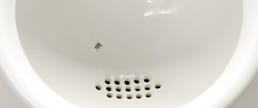
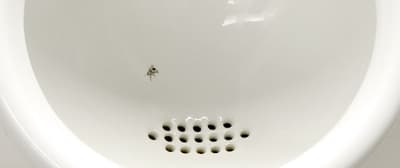
At Amsterdam’s Schiphol Airport, the small surprise sits just above the urinal drain, slightly to the left: a fly etched into the porcelain where a real fly would have made a very bad decision.[1] Look again and the trick gives itself away. Every urinal has one. Every fly is waiting in the same place.
The Schiphol fly is a tiny engraved target placed in men’s urinals at Amsterdam’s Schiphol Airport to improve aim. Managers credited it with reducing spillage and lowering toilet-cleaning costs, a small piece of bathroom psychology that traveled far beyond one airport.
The fly appeared at Schiphol in the early 1990s, inside a long, unglamorous fight against splashback.[1] In an airport restroom, missed aim is not a private annoyance. It is multiplied by thousands of travelers, then handed to the cleaning staff as odor, floor mats, mops, labor, and cost.
Urinal designers had already tried hardware. There were screens meant to let liquid in but not out, rubber mats, ribbed surfaces, and bowls shaped to send the stream back where it belonged.[1] Schiphol’s answer was smaller than all of that. It did not redesign the plumbing. It gave men something to hit.
Aad Kieboom, who was then involved with terminal extensions and renovations at Schiphol, is often linked to the fly’s introduction. Kieboom said the idea came from Jos van Bedaf, the airport’s cleaning department manager.[1] Van Bedaf had seen targets in urinals during his army days in the 1960s, and remembered the practical result: when there was a mark, men aimed at it.[1]
The insect itself mattered, but not because a fly was the only possible target. Klaus Reichardt, inventor of the waterless urinal, told Works That Work that men will aim at almost anything placed in the bowl, including a golf flag, a bee, or a little tree.[1] Schiphol chose a fly, small, dirty, annoying, and not especially terrifying. A spider might make a user flinch. A logo might feel like vandalism. A fly in a urinal creates permission.
The reported numbers made the little engraving famous. Later accounts say Kieboom reported an 80 percent reduction in spillage after the flies were introduced, along with an estimated 8 percent reduction in total toilet-cleaning costs.[4] Simple Flying also reports Schiphol’s estimate of an 8 percent cleaning-cost saving from adding the fly image to urinals.[2] The appeal was not only the savings. There was no sign to read, no lecture to obey, no rule posted above the sink.
Other places copied the basic idea. Urinal targets have appeared in airports, stadiums, and schools, sometimes as flies, sometimes as bees, ladybugs, bullseyes, or other marks.[3] The Schiphol fly also has older relatives. In late-19th-century Britain, pictures of bees appeared in toilets and urinals, partly as targets and partly as a joke on Apis, the honeybee genus.[3] In 1976, a New Jersey dentist patented a bullseye decal called the Tinkle Target, aimed at the same old problem.[3]
Schiphol’s version endured because it is almost embarrassingly modest. A traveler steps up, sees the little insect above the drain, and does what the cleaning department hoped he would do. Later, after the flights board and the restroom empties, there is a little less to mop from the floor.