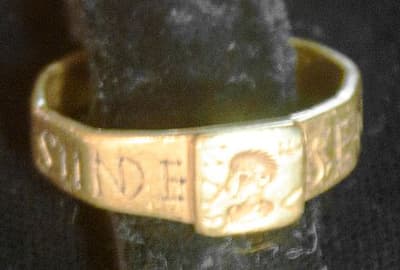
A farmer’s plough turned up the gold first. In 1785, in a field near Silchester in Hampshire, a large Roman ring came out of the soil, 12 grams of gold and broad enough that it may have been worn on a thumb or over a glove.[2] Around its band ran a name and a blessing with a mistake in it: “SENICIANE VIVAS IIN DE,” usually understood as an attempted “Senicianus, live in God.”[1]
The Ring of Silvianus is a fourth-century Roman gold ring found in Hampshire, later linked to a lead curse tablet from the temple of Nodens at Lydney. The tablet says Silvianus lost a ring and asked the god to deny health to Senicianus until it was returned.
The lead tablet came from somewhere else entirely. It was found at Lydney Park in Gloucestershire, about 100 miles from Silchester, at the site of a Roman temple dedicated to Nodens, a Celtic god adopted into Roman religious life.[2] The ring stayed with the Chute family at The Vyne, a country house in Hampshire, after its eighteenth-century discovery.[1] The two objects were separated by landscape, ownership, and time, yet they seemed to be talking about the same missing thing.
On the tablet, the complaint is unusually direct. In translation, Silvianus says he has lost his ring, gives half its value to Nodens, and asks that among those named Senicianus, none be allowed health until the ring is brought back to the temple of Nodens.[3] The curse names the owner, the suspected taker, the god, the object, and the punishment. It reads less like folklore than paperwork filed with heaven.
Thin lead sheets like this were part of the ordinary machinery of grievance in Roman Britain. People left curse tablets at sacred sites when a theft or dispute seemed beyond human repair.[4] A person who had lost something could scratch a name into lead, fold the metal, and hand the matter to a god. The scale of the loss did not have to be imperial. A ring was enough.
A Ring With the Wrong Name
The gold ring adds its own complication. Its square bezel is engraved with a figure usually described as Venus, with “VE” on one side and “NVS” on the other in mirror writing, so the image and letters would appear correctly when pressed into wax as a seal.[1] The band, however, addresses Senicianus, not Silvianus. If the tablet and ring belong to the same story, one possible sequence is plain enough: Silvianus owned it, Senicianus acquired it, and Senicianus’s name later ended up cut into the gold.
That sequence cannot be proved from the names alone. Some writers caution that the connection should not be assumed only because Senicianus appears on both objects.[1] Ancient Britain had more than one person, more than one ring, and more than one coincidence. Still, the match has been persuasive enough that the object is known by several names: the Ring of Silvianus, the Ring of Senicianus, and the Vyne Ring.[1]
In 1929, Sir Mortimer Wheeler was excavating at Lydney Park and reviewed earlier finds from the temple site. The curse tablet caught his attention, and Wheeler consulted J. R. R. Tolkien, then an Oxford scholar of language, about the name Nodens.[1] That consultation has made the ring famous far beyond Roman archaeology. A gold ring, a curse, a named owner, and a long shadow over possession all sound temptingly close to Tolkien’s later fiction, though whether he ever saw the ring itself remains uncertain.[2]
The National Trust displayed the ring at The Vyne in 2013, while later becoming more cautious about the Tolkien connection.[1] The caution is useful. The ring does not have to be the seed of Middle-earth to hold attention. It already has two inscriptions pulling in opposite directions: gold blessing Senicianus, lead asking Nodens to make him suffer.
The most secure facts remain small and stubborn. A fourth-century gold ring was found in Hampshire. A lead curse tablet from Gloucestershire named Silvianus, Senicianus, Nodens, and a lost ring. Between them sits a theft, an accusation, or a coincidence. The curse seems not to have brought the ring back to Lydney.[2] It survived instead at The Vyne, a heavy circle of Roman gold, still carrying Senicianus on its band.