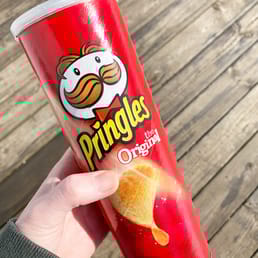
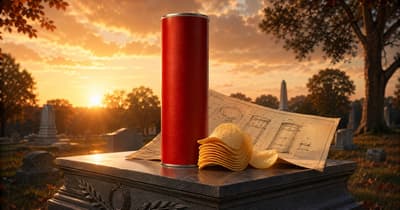
Fred Baur did not just help invent the Pringles can. He was so proud of it that when he died in 2008, his family buried part of his ashes in an Original Pringles can, exactly as he had requested.[1][2]
That sounds like an obituary detail designed in a writer’s room. But it gets better when you look at what Baur actually made. The can was not a gimmick attached to an ordinary snack. It was part of an engineering fix for a boring but persistent supermarket problem: potato chips kept arriving broken, stale, and cushioned by far too much empty air.[1][3]
Baur’s 1970 patent is wonderfully plain about it. Traditional chip bags, it says, left chips packed randomly, easy to crush, and exposed to oxygen and water vapor that sped up staling and rancidity.[3] So the answer was to redesign the whole system at once: make the chips uniform, stack them neatly, and slide them into a rigid tubular container that could actually protect them.[1][3] If you have ever reached into a Pringles can and pulled out an intact stack instead of a bag of salty shrapnel, you have felt the invention working exactly as intended.
That is the sneaky brilliance of Pringles. It feels like branding because the package is memorable, but underneath the mascot and the colors is a logistics argument. The tube keeps the chips from being crushed. The stacked shape cuts down wasted space. The sealed container keeps out moisture and oxygen.[3] NPR’s coverage of Baur’s burial made the same point: the can itself was a major reason the product stood out and sold by the millions.[1]
There is also something oddly touching about the rest of Baur’s career. According to The Cincinnati Enquirer, he worked on all kinds of food and storage problems at Procter & Gamble, including frying oils and a freeze-dried ice cream product that never became a hit.[2] Plenty of inventors make useful things. Much rarer is the inventor whose most famous creation becomes so recognizable that people know it from a silhouette. Baur built one of those.
That is why the burial story lasts. It is funny, yes, but it is also a reminder that ordinary objects are full of invisible decisions. Someone had to care enough about broken chips, stale air, and wasted space to turn a snack into a patented system.[3] Then, decades later, he cared enough about that system to take a small piece of it with him into the ground.[1][2]