At the Florida or Texas Gulf Coast, a ruby-throated hummingbird can leave the last perch behind and head for the Yucatán Peninsula. Ahead is about 800 kilometers of Gulf water, no flowers, no feeder, and no place to stop until the crossing is over.[1]
Ruby-throated hummingbirds can cross the Gulf of Mexico in one nonstop flight of about 500 miles, taking roughly 20 hours and relying on fat reserves they built before leaving land.
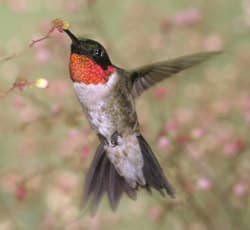
The bird attempting this is almost absurdly small. A ruby-throated hummingbird is only 7 to 9 centimeters long, with an 8 to 11 centimeter wingspan. Its weight can range from 2 to 6 grams, with males averaging about 3.4 grams and females about 3.8 grams.[2] Even after fattening for migration, the bird may weigh only about 5 to 7 grams when it launches across the Gulf.[1]
In summer, this is the familiar hummingbird of eastern North America, the metallic green blur at flowers and feeders, and the most common hummingbird in that part of the continent.[2] In winter, the species is generally in Central America, Mexico, and Florida.[2] The hard part is the space between those lives. Some ruby-throated hummingbirds migrate over land, where stopping is possible. Others take the direct line over the Gulf of Mexico, a route often described as roughly 500 to 600 miles of open ocean.[3]
The bird becomes its own fuel tank
Before the crossing, the hummingbird feeds heavily. Accounts of the migration describe birds eating in the days and weeks before departure to build fat reserves for the long flight; their weight may double before the Gulf crossing.[4] That extra mass is not a luxury. This is a bird whose ordinary metabolism is already extreme, powered by wings that beat about 80 times per second in normal flight and far faster during courtship display.[1]
Hovering flight is expensive because the wings do something most birds’ wings do not. In a ruby-throated hummingbird, they move forward and backward in a figure-8 pattern, producing lift on both strokes.[1] That machinery lets the bird hang in front of a flower, back away, dart sideways, and even fly upside down for brief moments.[1] The same tiny body that performs those backyard tricks must also become an endurance machine over water.
At an average migration speed of about 40 kilometers per hour, the Gulf crossing takes roughly 20 hours.[1] Other summaries of recorded flights describe nonstop trips of more than 500 miles, with one female ruby-throated hummingbird reported covering 580 miles in just over 23 hours.[5] For an animal that often feeds frequently during active hours, the crossing is a wager made in fat, timing, and weather.[3]
Why take the water route?
Ruby-throated hummingbirds breed across eastern North America, reaching into Canada, then move south as cold weather reduces flowers, insects, and feeding time.[2] Their annual travel can span thousands of miles between northern breeding areas and wintering grounds in Mexico and Central America.[3] The Gulf route is shorter than going around the water, but it leaves no margin for a bad fuel calculation.
Wind matters. Hummingbirds are described as timing Gulf crossings for favorable conditions, especially tailwinds that reduce the energy cost of the trip.[4] They also carry adaptations suited to long exertion, including efficient flight muscles, dense blood supply to those muscles, fat storage, and mechanisms that help conserve water and energy.[4] None of that makes the crossing gentle. It only makes it possible.
The backyard image of the ruby-throat is a bird suspended in sunlight, sipping from a flower as if it has escaped gravity. The migration image is stranger: the same bird, weighing less than a coin, leaving the coast with its body packed full of fuel, wingbeats stitching a path through the night until the dark water finally gives way to land.