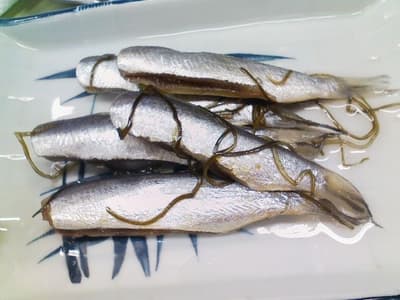
On the Cornish coast, a fish once sold as a pilchard came back to market in the 1990s with a cleaner, more Mediterranean name: sardine.[5] The fish had not become a different animal. It was still the small, silvery Sardina pilchardus that shoals in mid-water around Cornwall.[2][5]
“Sardine” is not one exact species. It is a food and market name used for several small, oily fish, and the species allowed under the label can change by country, region, size, and food standard.
The old word has always had a little slippage in it. “Sardine” entered English in the early 15th century and may come from Sardinia, the Mediterranean island around which the fish were once abundant.[1] But in ordinary commerce, “sardine” and “pilchard” never became precise scientific labels.[1]
In Britain, one rule of thumb has treated the name as a matter of age and size. The United Kingdom’s Sea Fish Industry Authority has classified sardines as young pilchards, while another criterion calls fish shorter than 6 inches, or 15 centimeters, sardines and larger fish pilchards.[1] Under that logic, the fish does not change species as it grows. It changes category on the counter.
The Can Has Its Own Rules
The canned-fish standard is broader than the fishmonger’s shorthand. The FAO and WHO Codex standard for canned sardines lists 12 species in the order Clupeiformes that may be classed as sardines, including Atlantic herring, Clupea harengus, and brisling sardine, Sprattus sprattus.[1] FishBase adds more everyday confusion, using “pilchard” for at least six species, “sardine” for more than a dozen, and many additional names that combine the words with qualifiers.[1]
That is why the same label can be honest in more than one place. Sardines are usually small, oily, nutrient-rich fish, eaten fresh, canned, smoked, pickled, dried, or salted.[1] They are also forage fish for larger fish, seabirds, and marine mammals, and are commercially used for bait, fish meal, and fish oil.[1] The word belongs partly to biology, partly to law, and partly to appetite.
Cornwall makes the naming problem visible. The Cornish Sardine Management Association identifies Cornish sardines as Sardina pilchardus, a pelagic fish in the clupeid family.[2] Its own description says smaller fish are often known as sardines, while more mature fish are fatter and longer.[2] Cornwall Good Seafood Guide puts it more plainly: Cornish sardines were traditionally known as pilchards, then rebranded in the 1990s as sardines.[5]
A Rebrand With Nets Behind It
At sea, the modern Cornish fishery uses ring nets in inshore waters. The net encircles a shoal, a drawstring rope closes the bottom, and the fish are scooped or pumped into iced holds.[5] The guide describes the fish as high quality, with 14 under-15-meter vessels working Cornish waters, each capable of catching up to 36 tonnes in a night.[5]
The rebrand did not make the fish trivial. In 2024, 8,719 tonnes of sardines were landed to Cornish ports, with a value of £2.93 million, according to MMO data cited by Cornwall Good Seafood Guide.[5] Local sellers still present them in very practical ways: grilled, barbecued, canned, or packed into recipes with fennel, saffron, pine seeds, and sultanas.[5][6]
So the word on the tin is simpler than the animal behind it. A sardine may be a Cornish pilchard, a brisling, or even a herring under a canned-food standard.[1][2] The label looks singular. The fish beneath it depends on the water, the ruler, the regulation, and the person doing the naming.