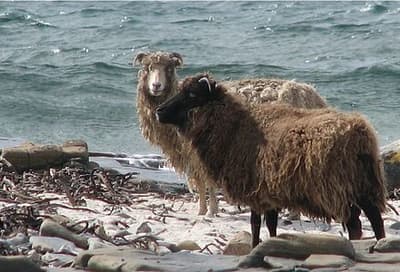
At low tide on North Ronaldsay, the sheep move down to the exposed shore. They do not head for pasture. They browse the wrack and kelp left bare by the sea, then wait out the returning water and ruminate when the tide comes in.[1]
North Ronaldsay sheep are a rare Scottish breed whose original island flock survives almost entirely on seaweed, after a 19th-century stone wall confined them to the foreshore to protect crofts and fields.
North Ronaldsay sits at the northern edge of Orkney, off Scotland’s north coast, and its sheep are small animals for such an odd reputation. Rams weigh about 30 kg, females about 25 kg, and both stand around 41 cm high. The rams are horned, the ewes mostly hornless, and their fleeces may be white, grey, brown, black, or reddish.[1]
Their fame comes from what they eat. The original semi-feral flock on North Ronaldsay evolved to subsist almost entirely on seaweed, one of the few mammals known to do so.[1] The habit was not bred in a laboratory or designed as a farming experiment. It began with a boundary.
The wall that changed the flock
In the early 19th century, islanders built a drystane dyke around North Ronaldsay. The wall stood about 1.8 m, or 6 ft, high, and it completely encircled the island, keeping the sheep on the foreshore and away from the crofts and fields inside.[1]
The shore had already been part of the island economy. Seaweed was used in kelping, the production of soda ash, but when kelping became uneconomical, the same coast took on a new role. The sheep were pushed outside the agricultural land to protect crops, and the beach became their pasture.[1]
Over generations, the flock’s daily rhythm shifted to the tide. When the water falls, the sheep graze on exposed seaweed. When the tide rises, they stop feeding and ruminate while the shoreline is covered again.[1] A field animal became, in practice, a tidal animal.
A body tuned to seaweed
Seaweed brings different minerals and different risks than grass. North Ronaldsay sheep extract the trace element copper far more efficiently than other breeds, because their seaweed diet supplies only limited copper.[1]
That adaptation has a cost. If North Ronaldsay sheep are fed on grass, they can be susceptible to copper toxicity, since high levels of copper are toxic to sheep.[1] The ordinary pasture world, the one most people associate with sheep, can become dangerous for a breed shaped by the shore.
The breed belongs to the Northern European short-tailed sheep group and has developed with little cross-breeding from modern breeds.[1] It was formerly kept mainly for wool, but today the two largest flocks are feral, one on North Ronaldsay and one on Auskerry, another Orkney island.[1]
Rarity now presses on the story. The Rare Breeds Survival Trust has listed North Ronaldsay sheep as a priority breed, and the sheep are considered in danger of extinction, with fewer than 600 registered breeding females in the United Kingdom.[1]
On North Ronaldsay, survival depends on a peculiar arrangement of animal, tide, seaweed, and stone. The sheep live because they learned the foreshore, and because an old wall kept the green fields on the other side.