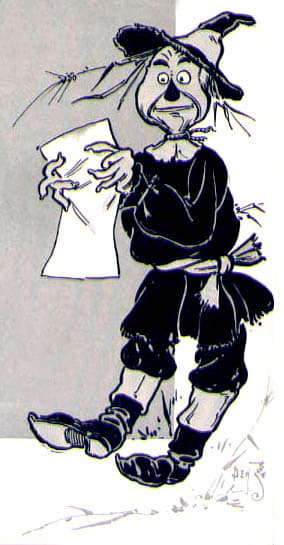
When the Wizard finally rewards the Scarecrow, he does not produce a brain in a jar or perform some Emerald City surgery. He hands over a diploma. The Scarecrow, newly certified as a “Doctor of Thinkology,” immediately proves himself with a grand bit of geometry: “The sum of the square roots of any sides of an isoscelese triangle is equal to the square root of the remaining side.”[1]
In The Wizard of Oz, the Scarecrow celebrates his diploma by reciting a mangled version of the Pythagorean theorem. He says “isosceles triangle” and “square roots,” but the real theorem concerns squares on the sides of a right triangle.
The sentence sounds learned for about two seconds. Then the math gives way. The Pythagorean theorem applies to right triangles, not isosceles triangles in general, and it relates the squares of the two legs to the square of the hypotenuse.[2] The Scarecrow says “square roots,” not squares. He says “any sides,” not the two sides adjacent to the right angle. He has the music of a theorem, but not the theorem.
David Pleacher, in a geometry lesson built around the scene, quotes the Scarecrow’s line and treats it as a classroom puzzle: it sounds like the Pythagorean theorem, but is not the Pythagorean theorem.[1] His conclusion is as plain as a red correction mark. The proposition the Scarecrow recites is never true.[1]
The Diploma Comes First
The mistake lands because the ceremony has already told the audience what to expect. The Scarecrow has spent the story wanting a brain, and in L. Frank Baum’s original Oz tale he is introduced as a character who believes he lacks one, even though he repeatedly proves capable and is later recognized as unusually wise.[3] The joke is not simply that he is foolish. It is that he needs official confirmation of a quality the story keeps letting him display.
The movie compresses that old contradiction into a tiny graduation scene. The Wizard gives him a title. The Scarecrow answers with academic confidence. “Isosceles” and “square root” are the kinds of words that can make a sentence feel intelligent if nobody stops to draw the triangle. On the page, the confidence becomes part of the comedy.
That is why the line has had such a long afterlife among mathematically alert viewers. A Movies & TV Stack Exchange discussion of the scene opens with the complaint that generations of “know-it-alls” have noticed the error, then lists the rival explanations people have offered: perhaps the filmmakers meant to show that the Scarecrow remained dim, perhaps “isosceles” sounded smarter, perhaps the actor said the wrong word, or perhaps the production simply made a mistake.[2]
The Wrong Triangle
The supplied sources do not settle which explanation is correct. What they do establish is the oddity itself: after receiving the symbol of intelligence, the Scarecrow immediately recites bad geometry.[1] If he had stated the theorem cleanly, the scene would have been tidy. Instead, it leaves a little snag in one of Hollywood’s most familiar endings.
Baum’s Scarecrow was never only an empty-headed straw man. He was naïve, newly made, and convinced he lacked something essential, even as his actions kept proving otherwise.[3] The movie’s botched theorem preserves that tension in one absurdly polished sentence: a straw man with a diploma, standing proudly beside the Wizard, leaving the audience with the wrong triangle.