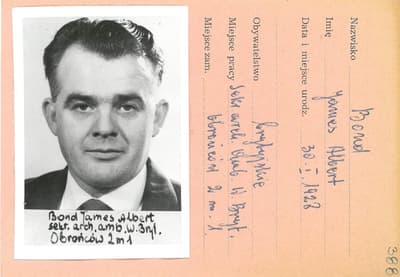
On February 18, 1964, a British embassy employee arrived in Warsaw with a name that made discretion almost impossible. He was James Albert Bond, from Devon, and he came with his wife and six-year-old son to take a low-ranking post at the British Embassy, officially as secretary-cum-archivist to the military attaché.[1]
Polish counterintelligence files show that a real James Albert Bond worked at the British Embassy in Warsaw in 1964, where communist authorities watched him and suspected him of gathering information on military facilities.
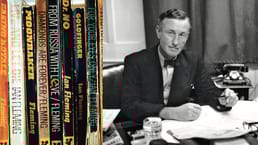
By the time Bond reached communist Poland, Ian Fleming’s fictional spy was already famous. Two Sean Connery Bond films had been released, and the third, Goldfinger, arrived in 1964.[2] For a man working near intelligence circles, the name was less a cover than a spotlight.
The file later found in the archive of Poland’s Institute of National Remembrance describes a life far less cinematic than the one his name suggested. James Albert Bond was born in Bideford, Devon, in 1928, and in Warsaw he held an embassy job filled with the dry furniture of bureaucracy: archives, military attaché paperwork, diplomatic cover.[3] The surviving record has no Aston Martin, no casino, no theatrical villain. It has a desk, a family, and a communist security file.
As a British diplomat in communist Poland, Bond was automatically placed under surveillance by Department II, the counterintelligence branch of the Ministry of Internal Affairs.[1] Officers described him as “talkative, but cautious,” and noted his interest in women.[3] Another account of the Polish reports called him “moderately intellectual,” “talkative,” “very careful,” fond of beer, and interested in women.[2]
A Famous Name Behind the Iron Curtain
Bond’s official job did not account for all of his movements. During his months in Poland, he made several trips to the northeast of the country while accompanying senior staff from the local SIS station.[1] Polish accounts say he was suspected of trying to gather information on military facilities, including in the Olsztyn and Białystok voivodeships.[2]
That kind of work had a Cold War logic. In the 1950s, Western intelligence personnel in Poland had taken trips through the countryside to photograph, map, and collect scraps of information about army units, training grounds, and railways.[1] Railway junctions mattered because they shaped how quickly Soviet and allied forces could move across the region. A 1955 British Joint Intelligence Committee memo, cited by the IPN, judged that stopping Red Army mobility would require nuclear bombing of fifty key junctions in Poland.[1]
By the mid-1960s, the atmosphere had shifted. The IPN notes that Western intelligence still cared about Poland’s military potential, but personal trips to photograph barracks were no longer the preferred method. Better-placed sources had become more useful, and countryside excursions could look as much like routine travel as espionage.[1]
That is what makes Bond’s posting so odd. Sir Richard White, then head of SIS, had authorized sending a low-level operative with a world-famous spy’s name into a country where communist counterintelligence already watched British diplomats.[1] One later account suggested the assignment may even have been a joke by British intelligence, since a man named James Bond at the British Embassy in Cold War Poland was almost guaranteed to be noticed.[2]
The File Without the Fireworks
The Polish officers did not uncover a grand adventure. Their file records suspicion, travel, personality notes, and little more. Within ten months, Bond sent his wife and son back to Britain for Christmas. A few weeks later, in January 1965, he left Poland too, apparently for good.[1]
What remains is an espionage story with the glamour drained out of it: an embassy job, surveillance notes, trips through northeastern Poland, and a name too loud for the work. The fictional Bond had a theme tune. James Albert Bond left behind a communist file describing a careful, talkative British embassy man whose name did most of the shouting.