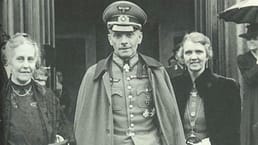
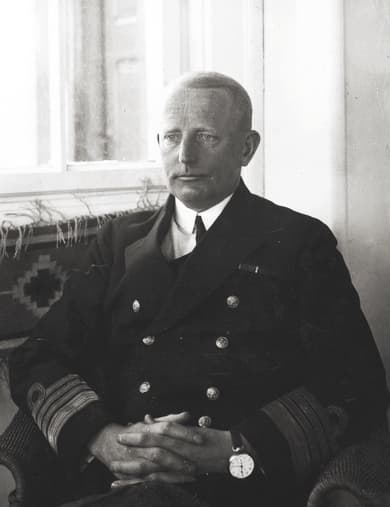
In captivity, Józef Unrug met German officers who had reason to expect recognition. They were speaking to a man born Joseph von Unruh in Brandenburg, trained in German schools, and seasoned in the Imperial German Navy. When they addressed him in German, he would not answer. He said he had forgotten the language in September 1939, the month Germany invaded Poland.[1][2]
Józef Unrug was a German-born Polish admiral who had once commanded submarines for Germany, then helped build Poland’s navy from almost nothing. After his capture in World War II, he rejected German appeals and refused to speak German, turning language itself into a line of allegiance.
His biography gave the Germans plenty to work with. Unrug was born in 1884 in Brandenburg an der Havel into a noble family of Prussian and Polish descent. His father, Thaddäus Gustav von Unruh, was a general in the Prussian Army. Józef studied in Dresden, completed naval college, and entered the Imperial German Navy in 1907.[1]
The old navy had shaped him deeply. During World War I, he served as a submarine commander, with listed commands including SM UB-25, SM UC-11, and SM UC-28. His service for Germany lasted until 1918, long enough to leave him with the training, habits, and reputation of a serious professional officer.[1]
In 1918, Poland returned to the map after more than a century of partitions, and Unrug chose the country tied to his ancestry rather than the one that had trained him. One account says he reported for Polish duty on 19 May 1919, at a moment when Poland lacked the basic equipment of a navy: no ship, no crew, and no seaport of its own.[2]
The first step was almost comically modest for a future admiral. Unrug used his contacts and experience to buy a ship in Gdańsk. The vessel, a German-built steamer from 1893, was later transformed into ORP “Pomorzanin” and used to train Polish sailors.[2]
The offices came after the ship. In 1920, Unrug became the first head of the new Hydrographic Office in Gdańsk. In 1925, after years spent organizing and developing the fleet, he was appointed commander of the Fleet of the Second Republic of Poland. In 1933, he was promoted to rear admiral.[2]
By the time Germany attacked Poland in 1939, Unrug was no symbolic convert. He was commander-in-chief of the Polish Navy during the opening phase of World War II, and another account places him at the forefront of the defense of Hel and the Polish coast.[1][2] When he was captured, he became a German prisoner of war. The Germans made offers for him to change sides. He refused them all.[1]
The prison-camp language story has lasted because it compresses the contradiction into one room. The man refusing German had German birth, German schooling, German naval service, and German honors. He also had Polish allegiance and a navy he had helped assemble from a purchased steamer, a hydrographic office, public effort, and years of command.[1][2]
His captivity took him through several Oflags, including Colditz Castle.[1] The old acquaintances, the old naval world, and the old language could still be brought before him. Unrug’s answer was to treat September 1939 as a border. On one side stood the language of his youth. On the other stood the invaded country he had chosen.
After the war, Unrug remained in exile, living in the United Kingdom, Morocco, and France. He died in France in 1973 and was buried there.[1] In 2018, his remains and those of his wife, Zofia, were exhumed from Montrésor and taken to Gdynia, Poland, for their final resting place. That same year, Poland posthumously promoted him to vice admiral.[1]
The officer who said he had forgotten German ended up beside the Polish sea, returned not as Joseph von Unruh of Brandenburg, but as Józef Unrug of Gdynia, near the navy he had helped bring into being.