Somewhere on a 1974 military food survey, after Spanish rice and before tomato juice, a soldier met item 339: Funistrada. The form did not wink. It did not confess. It sat there with the same calm official confidence as mashed potatoes, root beer, turkey pot pie, and creamed chipped beef.[1]
On the Army's 1974 food preference form, Funistrada looked like another mess hall item, but it was a fake name. Researchers used the invented dish to see how many service members would answer even when the food did not exist.
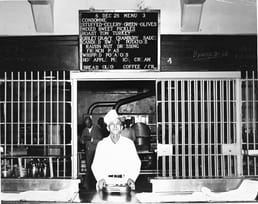
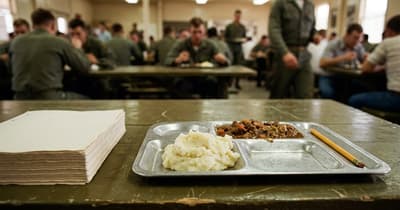
In 1974, the U.S. Army Natick Development Center's Food Sciences Laboratory had to turn appetite into logistics. Researchers asked enlisted personnel in the Army, Navy, Air Force, and Marine Corps what they actually wanted to eat. The survey covered 378 foods and asked both how much people liked each item and how often they wanted it served.[1]
Inside the 378-item list, researchers hid ten duplicate food names and three deliberate inventions. The duplicates checked whether answers stayed consistent. The nonsense names checked something more human: whether a person would respond to a word that merely sounded edible. The fake foods were buttered ermal, braised trake, and Funistrada.[1]
When the Food Sciences Laboratory counted the forms, Funistrada had done its work almost too well. It had the highest share of "never tried" answers, 84 percent, which means most respondents recognized the limit of their experience. A stubborn minority still gave an answer. Across the three fictitious names, 16 to 20 percent of the sample responded as if one of these invented dishes had a place somewhere in military life.[1]
A service member staring down a long government form would not have needed much help believing in a strange menu item. Some foods were familiar. Some were already odd. Some had the flat authority of mess hall phrasing. If the Army asked about braised trake, maybe braised trake was served at another base. Maybe someone else knew. Maybe it was easier to bubble in an opinion than to admit the menu had finally outrun you.
After the report, the fake names wandered into the broader folklore of military food. Paul Dickson's military food history CHOW included braised trake and buttered ermal among food slang and foolers, according to Kirkus Reviews.[2] Years later, Funistrada lived online as a kind of ghost dish. A 2007 blog post called it the Army's "ghost food" and noted how many retellings repeated the story before anyone had pinned down the original report.[3]
A single blank bubble beside Funistrada caught a reflex every bureaucracy knows. People answer forms with knowledge, but also with fatigue, politeness, confidence, boredom, pride, and the desire to keep moving. A nonsense word can expose that better than a lecture on methodology. Put it between real foods, print it in the same type, and the human mind starts seasoning it.
At the end of the survey, Funistrada still had no recipe, no kitchen, and no tray slot. Its whole career happened in the space between a blank bubble and a person deciding whether to fill it in. The Army thought it was testing food preferences. For one item on the page, it was testing the appetite to have an answer.
Sources
- Herbert L. Meiselman, Day Waterman, and Lawrence E. Symington, "Armed Forces Food Preferences," U.S. Army Natick Development Center Food Sciences Laboratory, December 1974
- Kirkus Reviews, review of Paul Dickson's CHOW: A Cook's Tour of Military Food
- Entropic Memes, "Funistrada, the Army's 'Ghost Food'"