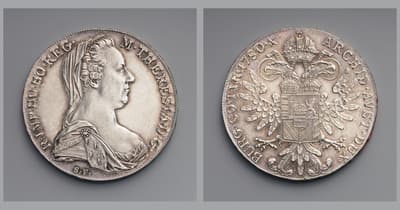
People accepting Maria Theresa thalers could be very particular about a dead empress's jewelry. According to researcher Clara Semple, they counted the pearls on her brooch and checked the feathers on the eagle stamped on the other side. These were details on a silver coin that had traveled far beyond Austria, and a buyer could reject one that failed to match the familiar 1780 design. Keeping the money acceptable meant keeping the empress recognizable.[1]
Maria Theresa died in 1780, but the coins continued making their way through the Middle East and northeastern Africa, where traders used them in commerce with India and China. Mints kept supplying the portrait people knew, with the year of her death still stamped on the silver. Twentieth-century examples retained even the initials of eighteenth-century mint officials.[2]
The Details Buyers Expected to See
When Semple encountered the thaler in Riyadh's women's market in 1968, she was researching Arabian jewelry. The coin appeared in pendants and more elaborate ornaments, sometimes surrounded by stones or fringed with bells and chains. In Yemeni markets she saw people exchange thalers for goods and use them as standard weights. Her interest followed the coins out of the jewelry market and into merchants' stories, travelers' accounts and mint records.[1]
From that research came her account of people examining the brooch and eagle before accepting payment. A tiny feature on the portrait could matter to someone who had no connection to the Austrian court. The British Museum describes the familiar design as a source of confidence in the coin, helping explain why later manufacturers preserved so much of it. Maria Theresa kept her place on money circulating long after her reign.[1][2]
As traders continued to need thalers, production spread beyond the Austrian mints. London made them for British traders, and during the Second World War they were also struck in India. Each new batch could carry the old portrait, imperial eagle and date into another transaction, without asking the recipient to become acquainted with a different ruler.[2]
Fresh Coins With an Old Date
On November 5, 2002, a press operator at the Austrian Mint finished a two-day production run. In his report for Aramco World, Peter Harrigan described nearly 2,000 proof coins being wrapped individually in glassine. Most of the ordinary coins were packed 500 to a burlap bag, ready for banks and dealers. All were dated 1780.[1]
Orders from the United States and England had caught the mint with low stocks, its marketing director, Kerry Tattersall, explained. Another striking supplied the shortage, and the Austrian Mint still offers the coin today. Its product description identifies the design with the year Maria Theresa died. Anyone trying to work out a specimen's age therefore needs more than the date visible on its face.[1][3]
During her travels, Semple also watched silversmiths throw thalers into crucibles to make jewelry. The silver that had passed inspection as a familiar coin could be melted down and worked into an ornament, with the empress's carefully preserved features disappearing into the pot.[1]
Sources
- Peter Harrigan, Tales of a Thaler, Aramco World (2003)
- British Museum, Maria Theresa thaler
- Austrian Mint, Maria Theresa Taler Silver Uncirculated
Image: Two sides of a Maria Theresa thaler in The Metropolitan Museum of Art, Anonymous Gift, 2010. Public-domain photographs, cropped and arranged side by side. View the museum object.