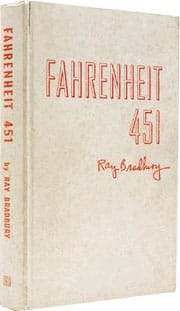
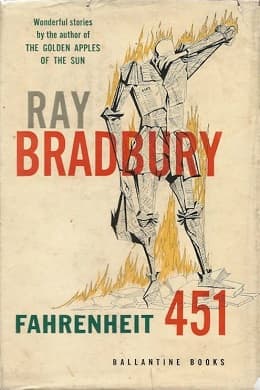
A teacher at Venado Middle School in Irvine, California, had an assignment in 1992 that sounded as if Ray Bradbury had planted it there himself: take student copies of Fahrenheit 451, find the “obscene” words, and make them vanish under black marker before the books reached class.
In 1992, Venado Middle School in California had teachers black out “obscene” words in Fahrenheit 451. The school stopped after local newspapers pointed out the irony of censoring a novel famous for condemning censorship.
Bradbury’s novel had been published in 1953, its title drawn from the temperature at which book paper was said to catch fire and burn.[1] The central image is blunt enough for a teenager to remember: firemen who do not put out fires, but start them, burning books for a culture that has decided reading is dangerous.[1]
At Venado, the school was trying to manage classroom language, not stage a lesson in irony. Teachers were told to cover words considered obscene with black marker before issuing the books to students.[1] What came back was an object with two messages on the same page. Bradbury’s printed sentences warned about the destruction of books. The school’s ink marks showed a smaller, tidier version of the same impulse.
A Book People Kept Trying To Clean Up
The Irvine episode was part of a longer, stranger publishing history. Ballantine Books had once issued an expurgated school edition of Fahrenheit 451 for high school students, with passages altered to remove or soften language.[1] Bradbury later objected to the changed text, and the unaltered version was restored.[1]
The edits point to a recurring adult anxiety around the book. A word on the page becomes the immediate problem. The larger question, the one Bradbury built the novel around, is easier to miss: who gets to decide what a reader is allowed to encounter, and how much of a book can be removed before the act of protection starts to resemble the thing being condemned?
In 1987, another school dispute put Fahrenheit 451 into a “third tier” category in Bay County, Florida, under a classification system created while Leonard Hall was superintendent.[1] That tier was for books to be removed from classrooms because they contained “a lot of vulgarity,” according to the novel’s censorship history.[1] After a class-action lawsuit by residents, media attention, and student protests, the school board abandoned the tier system and approved the books then in use.[1]
The Marker Made The Argument
The Venado Middle School practice ended under a simpler pressure. Local newspapers commented on the irony, and the school stopped blacking out the words.[1] No elaborate literary theory was needed. A censored copy of Fahrenheit 451 explained the problem by existing.
That is what gives the episode its staying power. Bradbury did not need every censor to be a villain with a torch. His book imagined a culture that grows comfortable with subtraction. A sentence loses a word. A student receives a prepared version. A classroom avoids a complaint. The damage can look administrative, even polite.
For a short time in 1992, a middle school copy of Fahrenheit 451 carried the whole argument in a student’s hands: the warning in type, and the black marker dragged across it.