When Maria Ann Smith found a promising apple tree beside the creek on her farm near Sydney, she invited a neighboring grower and his young son to have a look. She told them it had sprung up where she had dumped rotten French crab apples from Tasmania. The boy, Edwin Small, recalled the 1868 visit decades later, when the tree's fruit had acquired the name people used for its owner: Granny Smith.[1]
Small was about twelve at the time, and his recollection reached print through local historian Herbert Rumsey in 1924. He was describing a childhood visit more than fifty years later, so the discarded apples belong to a remembered account of the tree's origins. Maria and her husband, Thomas, arrived in Australia from England in 1838 with five surviving children. In 1855 and 1856, they bought farmland in what is now Eastwood, where their orchard sloped down toward the creek, with room for vegetables and poultry.[1]
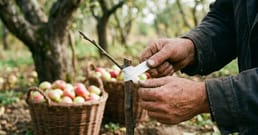
From that farm, Maria made a weekly journey to sell her produce. According to the City of Ryde's history, she walked to Ryde Wharf on Mondays, caught the ferry into Sydney and worked at the markets until returning home on Friday. Customers there knew her as Granny Smith. Her apple had a woman with years of growing and selling experience to look after it, and she propagated the new variety. Family tradition describes her grafting branches and sharing cuttings with neighboring orchardists.[1][2]
Those growers could pass the apple along without knowing exactly how it had come into being. Its parentage remains uncertain. Speaking to ABC News in 2025, University of Sydney professor Daniel Tan described the theory that it arose from a natural cross between a domesticated apple and a crab apple. It was a chance seedling, rather than the product of a deliberate breeding cross. Maria's contribution was to recognize and cultivate what had appeared on her land.[2]
She died in March 1870, leaving other people to carry the apple into commercial cultivation. Edward Gallard, who later bought part of the Smith farm, planted it extensively. In 1890, growers exhibited the fruit at the Castle Hill Agricultural and Horticultural Show as Smith's Seedling; a year later, it won the cooking-apple prize as Granny Smith's Seedling. In 1895, the New South Wales Department of Agriculture recommended the variety for export and began growing it at its experimental station in Bathurst.[1]
The firm, tart green apples became familiar in fruit bowls and pies far beyond the district where Maria had sold her produce.[2][3] Her name still brings some of their admirers back to Ryde. In 2025, local historian Janice Eastment told ABC that she had recently taken two groups of visitors to Granny Smith's headstone, where they were astonished to find the woman behind their favorite apples. At St Anne's Cemetery, Maria's headstone is crowned with an arch of apples and leaves.[2]
Sources
- City of Ryde Libraries: Granny Smith, The Name, The Fruit, The Legacy
- ABC News: How the famed Granny Smith apple came from a chance seedling in Eastwood
- Wikipedia: Granny Smith (context)
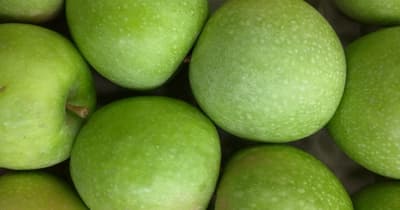
Image: Modern Granny Smith apples, illustrative. Photo by Assianir via Wikimedia Commons, CC BY-SA 3.0. Cropped and resized; derivative under the same license.