A person who saves the seeds from a Red Delicious has done the most natural thing in the world, and possibly the least useful thing in the orchard. Iowa State Extension puts the disappointment plainly: a seed taken from a Red Delicious apple will not produce a Red Delicious apple tree. The seedling will be genetically different, and usually worse than its parent.[1]
Most supermarket apple varieties survive as living copies. Growers keep a Honeycrisp, Gala, or Red Delicious recognizable by grafting a piece of that variety onto rootstock, because seeds reshuffle the apple instead of repeating it.
Iowa State says most apple trees are propagated by grafting because grafting lets growers produce trees that are genetically identical to one another.[1] That little sentence explains why an apple aisle can look so orderly. Behind every neat row of named fruit is a nursery trick: keep the top part faithful, then borrow roots from another tree.
Minnesota Extension tells home growers to order nursery trees that graft the fruit variety onto selected rootstocks, so buyers can choose the combination they want.[2] The Royal Horticultural Society gives the same practical advice from the other side of the Atlantic: apples are grafted onto rootstock, and the rootstock controls the size and vigor of the tree.[3]
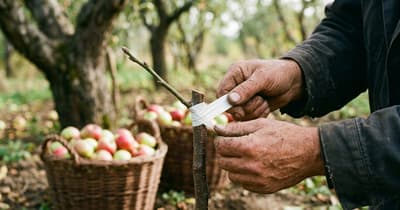
In the nursery, the fruiting part has a wonderfully bodily name: the scion. A grower cuts a twig from the variety people want, joins it to a rootstock, and waits for the wound to knit into one working plant. The future apple is decided above the graft union. The roots may decide how tall the tree gets, how quickly it fruits, and how easy the harvest will be, but the scion decides whether the bin says Gala or Fuji.[2]
Wikipedia puts the commercial reason in plain terms: apple cultivars are propagated by clonal grafting onto rootstocks, since seed grown apples often differ from their parents and lack the desired traits.[4] A grocery sticker can look like a family name. In the orchard, it is closer to a chain of carefully kept continuations.
Seeds still matter. They are how breeders chase new varieties, because each one carries a shuffled possibility. For the rest of us, though, the saved seed is a lottery ticket, not a recipe. Plant it and you may get a tree. You probably will not get the apple you packed into a lunchbox.
Modern abundance depends on refusing that lottery. A familiar apple reaches you because someone once liked a tree enough to copy it with a knife, a strip of tape, and a living twig. The next time a grocery bin offers a dozen apples that look almost interchangeable, the sameness is the marvel: an orchard full of repaired little joins, quietly keeping one old bite alive.