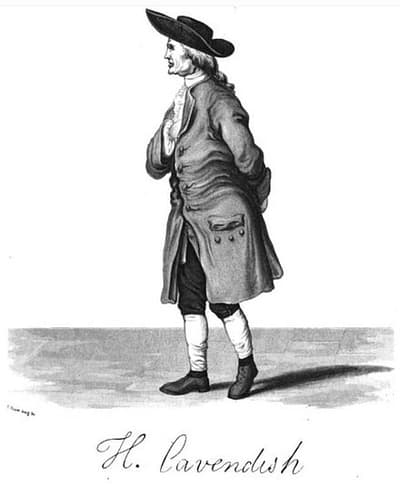
The instruction did not have to be spoken. In Henry Cavendish's house, a female servant could receive his wishes on paper rather than from his mouth. By one account, the arrangement went even further: a back staircase was added so the master of the house could move through his own rooms without meeting his housekeeper face to face.[1]
Henry Cavendish, the English scientist famous for identifying hydrogen as "inflammable air," was also remembered for extreme shyness, including written instructions to female servants and, by one account, a staircase built to avoid a household encounter.
On the scientific record, Cavendish looks almost impossibly capable. He worked on gases, atmospheric air, the synthesis of water, electricity, heat, and the density of the Earth, and later accounts praised the accuracy and precision of his experiments.[1] In daily life, the same man appears to have treated ordinary contact as something to be managed with the care of a laboratory procedure.
Cavendish was born on 10 October 1731 in Nice, where his family was living at the time.[2] His mother, Lady Anne de Grey, died when he was very young, shortly after the birth of his brother Frederick.[3] At 11, he attended Hackney Academy near London. At 18, he entered Peterhouse, Cambridge, then left three years later without taking a degree, which was not unusual for a man of his station.[3]
After Cambridge, the important room was the laboratory. Cavendish lived with his father in London, where he soon had his own space for experiments.[3] His father, Lord Charles Cavendish, belonged to scientific circles, and in 1758 began taking Henry to meetings of the Royal Society and dinners of the Royal Society Club.[3] By 1760, Henry Cavendish had been elected to both groups.[3]
The Gas He Called Inflammable Air
In 1766, Cavendish published On Factitious Airs, describing a gas he called "inflammable air."[1] He measured its density and observed that it formed water when burned.[1] Antoine Lavoisier later reproduced the experiment and gave the element its modern name, hydrogen.[1]
The discovery was only one part of a wider scientific life. Cavendish studied the composition of atmospheric air, the properties of different gases, electrical attraction and repulsion, a mechanical theory of heat, and calculations of the density, and therefore the mass, of the Earth.[1] The experiment associated with that last question became known as the Cavendish experiment.[1]
At the Royal Society, Cavendish had access to the formal world of eighteenth-century science. He was elected to scientific groups, received the Copley Medal, and moved among men whose work helped shape modern chemistry and physics.[1] Yet accounts of his public life often return to withdrawal. One modern summary says Charles Blagden helped him enter London's scientific society and acted as a representative when Cavendish was too shy to speak before crowds or committees.[4]
A House Built for Avoidance
The household stories endure because they make his reserve visible. Notes to servants are small things, but they turn shyness into an object someone could hold. The reported back staircase does something stranger: it turns avoidance into architecture.[1]
Modern writers have sometimes suggested that Cavendish may have been on the autism spectrum, but the safer historical record is behavioral rather than diagnostic: he was described as intensely shy, unusually private, and drawn to controlled forms of communication.[3] The caricature would be easy, a brilliant recluse hiding from the world. The record is more specific. Cavendish did enter scientific institutions, publish important work, and take part in the networks around the Royal Society.[1]
What he avoided, at least in the stories that survived, was the unscripted encounter. The man who measured gases no one could see also left behind a more domestic image: a written instruction in a servant's hand, and a staircase that let Henry Cavendish pass through his own house unseen.