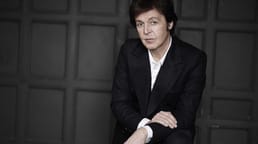
In Derry, Father Edward Daly waved a blood-stained handkerchief like a white flag while men carried a dying marcher through the street. The photograph and television images traveled beyond Northern Ireland. In London, Paul McCartney read the newspapers, sat down at a piano, and wrote a song whose title some British broadcasters would not even say aloud.[1][2]
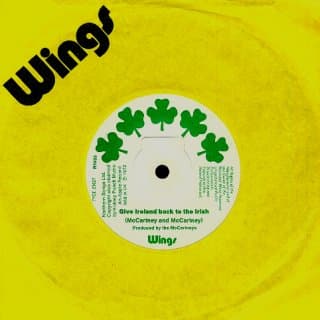
Paul and Linda McCartney wrote “Give Ireland Back to the Irish” after Bloody Sunday in 1972, and Wings released it as the band’s debut single. The BBC and other UK broadcasters banned it, many US radio programmers avoided it, yet it reached number one in Ireland.
Bloody Sunday had taken place on 30 January 1972, during a civil rights march in Derry. British soldiers shot unarmed civilians, killing 13 that day, with another victim later dying from his injuries.[1][2] For McCartney, the violence was not remote. Liverpool, his home city, had deep Irish ties, and he later said that “half of Liverpool comes from Ireland.”[1]
The next morning, McCartney began writing from what he called a British point of view. He remembered reading the papers and thinking that what the British Army was doing “looked a bit wrong,” then starting the song at the piano.[2] The lyric was blunt. It addressed Great Britain directly, asked what it was doing “in the land across the sea,” and invited listeners to imagine being stopped by Irish soldiers on the way to work.[3]
A risky first single
Wings was still a new band. Paul and Linda McCartney had formed it in 1971 with Denny Laine, Denny Seiwell, and Northern Irish guitarist Henry McCullough.[1][2] “Give Ireland Back to the Irish” became the group’s debut single, recorded in London at EMI and Island studios on 1 and 3 February 1972, only days after the shootings.[2][4]
McCartney had not been known for overtly political singles. He later admitted that he had once thought John Lennon was “crackers” for making political records.[2] Bloody Sunday changed the distance. In his account, the violence was close enough and visible enough that saying nothing no longer felt defensible.[2]
EMI saw the danger before the public heard the record. McCartney later recalled that the company’s chairman phoned him to say the label did not want to release it because it was too inflammatory. McCartney pushed back, EMI relented, and the chairman warned him it would be banned.[1]
The banned title
The warning proved accurate. The BBC and other British broadcasters refused to play “Give Ireland Back to the Irish.” Radio Luxembourg also declined it, and when chart listings mentioned the single, it could be described only as a record by Wings, not by its title.[1][4] McCartney tried to buy airtime on British commercial television, but regulators would not allow that either.[1]
In the United States, most radio programmers also passed over the single.[4] The ban did not keep it off the charts. It reached number 16 on the UK Singles Chart and number 21 on the Billboard Hot 100.[4] In Ireland, where the title landed differently, it topped the Irish Singles Chart for one week in March 1972.[4]
Critics were harsh. Some called the lyrics simplistic and saw the single as an attempt to give McCartney’s new post-Beatles band political credibility.[4] British media also condemned him for what they viewed as a pro-IRA position, though the song itself was framed around British rule and British military action in Northern Ireland.[4]
The strange part is how little disguise the record wore. No fictional country, no coded villain, no softened title for radio. Wings arrived with a debut single that broadcasters tried to reduce to “a record by the group Wings,” while Irish listeners put the forbidden words at number one.