
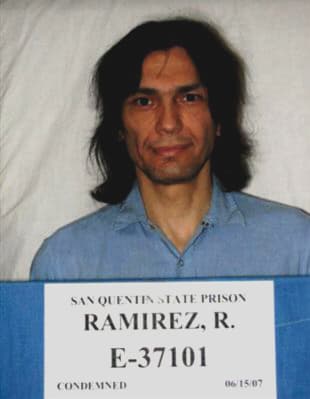
There are crimes so monstrous they seem as though they should repel everyone forever. No admirers. No romance. No wedding cake. No vows.
And then there is Richard Ramirez.
The man the public came to know as the Night Stalker was convicted of murdering 13 people in California during a home-invasion spree that terrorized Los Angeles and San Francisco in 1984 and 1985. He raped, tortured, beat, shot, stabbed, and taunted his victims. He invoked Satanic imagery in court. He entered the national imagination not as a dark antihero, but as something far worse: a predator who seemed to delight in fear itself.[1]
Which is what makes what happened next feel so implausible. In 1996, while on death row at San Quentin, Ramirez married one of his admirers, a magazine editor named Doreen Lioy. She had reportedly written him dozens of letters during his trial and remained devoted to him long after the guilty verdict. In one of the strangest afterlives ever attached to an American murder case, a serial killer became a husband.[1]
The Killer Who Became a Spectacle
Ramirez did not emerge from obscurity as an ordinary criminal. Born Ricardo Leyva Muñoz Ramírez in El Paso in 1960, he spent the mid-1980s turning Southern California into a geography of dread. His attacks were not neat or patterned in the way people often imagine serial murder to be. He used guns, knives, a tire iron, a hammer, a machete. He targeted men, women, couples, the elderly. He entered homes at night and made the most intimate place in a person’s life feel suddenly porous and unsafe.[1]
That randomness was part of the terror. People could not reassure themselves that they were the wrong age, in the wrong neighborhood, part of the wrong demographic. Ramirez did not seem to be following a script. He was following opportunity. By the time he was captured in 1985, the Night Stalker case had become one of the most notorious crime stories in America.[1]
And notoriety does something strange in modern culture. It can flatten moral reality. It can turn horror into iconography. Ramirez’s blank stare, long hair, courtroom grin, and Satanic posturing made him legible to a certain kind of attention. Not sane attention. Not admirable attention. But attention all the same.[1]
The Woman Who Said Yes
Doreen Lioy was not a passing curiosity-seeker. She was one of the women who wrote to Ramirez while he awaited the final outcome of his case, and over time she became the most committed of them all. According to later accounts, she sent him dozens upon dozens of letters and defended him publicly with an intensity that seemed almost impossible to square with the evidence against him.[1]
Then, in 1996, she married him inside San Quentin State Prison.[1] It is one of those facts that lands with a thud because it forces you to confront something deeply uncomfortable: for some people, infamy does not erase attraction. It distorts it. Repackages it. In the warped logic of celebrity culture, even a death-row inmate can become the center of fantasy if enough people project myth onto the man and refuse to look directly at the crimes.
But the marriage was built on a peculiar kind of denial. Ramirez had already been convicted. The brutality of his crimes was not speculative. It was documented in testimony, evidence, and verdicts. To remain loyal to him required more than affection. It required an active refusal to absorb what he had done.[1]
The Crime That Changed Even This
And yet there was, apparently, a line.
For years, Lioy stood by him. Then, in 2009, she left him after DNA evidence linked Ramirez to the rape and murder of a 9-year-old girl, Mei Leung, in San Francisco in 1984.[1] That detail matters, and not just because it is horrifying. It matters because it reveals the fragile architecture of selective belief.
Ramirez was already known as a murderer, a rapist, a home invader, a sadist. But confirmation that he had also killed a child seems to have shattered whatever psychological barrier had allowed devotion to survive. The same man, the same record of cruelty, the same public history, and yet one newly confirmed crime made continued loyalty impossible.[1]
There is something grimly revealing in that. People often imagine denial as a total state, as though someone either accepts reality or rejects it whole. In practice, denial is usually much stranger. It is negotiated. Compartmentalized. A person can know the broad outline and still cling to some internal loophole, some last private fiction that keeps the unbearable at arm’s length. DNA closed that loophole.[1]
The Child Victim in the Margins
Mei Leung’s murder came before Ramirez became a household name. In April 1984, the 9-year-old girl was abducted, raped, and murdered in the basement of the hotel where she lived with her family in San Francisco.[1] For years, that killing sat adjacent to the better-known Night Stalker case rather than fully inside the public mythology surrounding it.
Then forensic science did what memory and spectacle often fail to do. It cut through narrative. It attached the crime to the man with biological certainty. And with that, Ramirez’s known toll widened beyond the 13 murders for which he had long been infamous. The number was no longer just adults. It included a child.[1]
If there is a lesson in that development, it is not merely that forensic methods improve over time. It is that notoriety can conceal as much as it reveals. The famous version of Richard Ramirez, the one reproduced on tabloid covers and crime specials, was already terrible. The fuller version was worse.
What the Marriage Actually Tells Us
It would be easy to tell this story as a lurid footnote, a grotesque bit of trivia about a serial killer who found a bride behind bars. But the story endures because it exposes several uncomfortable truths at once.
First, violent fame is still fame. Second, some people are drawn not despite evil but through the aura that public evil creates. And third, even the most extreme acts of loyalty can depend on carefully managed illusions. Lioy married Ramirez in prison in 1996 and remained with him for years. But when DNA tied him to the murder of Mei Leung, the fantasy appears to have collapsed under the weight of a fact too stark to domesticate.[1]
Ramirez died in 2013 while awaiting execution, never having been put to death.[1] The marriage did not survive him by long, because in a sense it had already ended years earlier, when new evidence made an already monstrous man even harder to mythologize.
And that may be the strangest part of the whole story. Richard Ramirez did not become worse in 2009. He had always been Richard Ramirez. What changed was that one more victim, a 9-year-old girl, was no longer hidden in the haze of his legend. She was placed back where she belonged, at the center of the truth.[1]