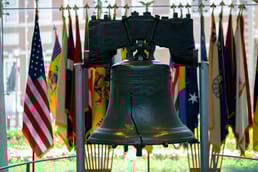
At 8:45 on a Monday morning in Philadelphia, National Park Ranger Rick Starr was heading into what he remembered as a dull briefing at the Liberty Bell Center. Then he saw reporters outside with notebooks. A camera crew followed. Inside, coworkers had newspapers in their hands and a question that sounded too foolish to need answering: had the Liberty Bell really been sold to Taco Bell?[3]
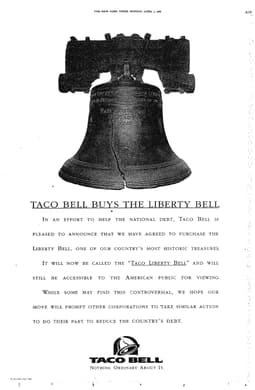
On April 1, 1996, Taco Bell announced in full-page newspaper ads that it had bought the Liberty Bell and renamed it the “Taco Liberty Bell.” The announcement was an April Fools’ Day prank, but for several hours many Americans treated it as real.
The ad sounded calm, official, and almost offensively reasonable. “In an effort to help the national debt,” Taco Bell said it had agreed to purchase “one of our country’s most historic treasures.” The bell would still be available for public viewing, the copy promised, only now under the name “Taco Liberty Bell.” The company hoped other corporations might take similar action to reduce the national debt.[2]
Full-page ads ran that morning in six major newspapers: The Philadelphia Inquirer, The New York Times, The Washington Post, The Chicago Tribune, The Dallas Morning News, and USA Today.[1][2] The joke worked partly because the format looked so serious. A fake announcement printed in the country’s major papers did not feel like a gag at first glance. It felt like corporate America had found one more surface to brand.
At Independence National Historical Park, the phones began to ring. Hundreds of angry citizens called the park, and other accounts describe thousands of calls to Taco Bell headquarters and the National Park Service.[1][2] Park Service spokeswoman Elaine Sevy said, “We were shocked. We had no idea this was happening. We have just been getting hammered with phone calls from the public.”[2]
Ranger Larry McClenney later remembered a coworker with “a phone on either side of her head,” trying to answer callers demanding, “How could you sell this national icon?”[3] Staff aides from the offices of Senators Bill Bradley and J. James Exon were among those who called.[2] By midmorning, the Philadelphia branch of the National Park Service had arranged a news conference to calm people down. “The Liberty Bell is safe. It’s not for sale,” a spokeswoman announced.[2]
The premise was impossible in a way many callers did not know. The ad implied that the federal government could sell the Liberty Bell to help pay down the national debt. In fact, the bell was the property of the City of Philadelphia, not the federal government.[2]
The Joke Reaches the White House
At noon, Taco Bell admitted the announcement was a hoax.[1] The ad had been created by Jon Parkinson and Harvey Hoffenberg at Bozell, Taco Bell’s advertising agency, and the campaign later won industry awards.[1] One account also reported that Taco Bell made a donation connected to Liberty Bell preservation as part of the reveal.[4]
The sharpest answer came from the White House. When Press Secretary Mike McCurry was asked about the supposed sale, he said the federal government was also selling the Lincoln Memorial to Ford Motor Company. It would be renamed the “Lincoln-Mercury Memorial.”[1][2]
As advertising, the prank was unusually efficient. The campaign cost about $300,000, according to one account, and generated an estimated $25 million in free publicity. Taco Bell also saw a sales increase of more than $1 million during the first two days of April.[1] David Paine, founder of the public relations agency that executed the campaign, later called it “the most successful project I’ve been involved with.”[1]
The Taco Liberty Bell existed as a supposed fact for only a few hours. By afternoon, the joke had collapsed back into an ad campaign. In Philadelphia, though, park employees had spent the morning answering ringing phones while the cracked bronze bell sat where it had been all along, suddenly defended by strangers who had discovered how quickly a prank could feel like a theft.