The letters kept arriving at Warp from players who were doing something Kenji Eno had not designed for. They were blind fans in Japan, writing to say they loved his games, even though those games had been built as visual experiences that forced them to work around the screen.[1]
Real Sound: Kaze no Regret was Kenji Eno’s 1997 answer to those blind fans: a Sega Saturn audio adventure with a blank screen, made so blind and sighted players could follow the same story through sound.[1]
Eno did not treat the letters as a compliment and move on. The development story preserved around Real Sound begins with those fans and with his attempt to understand how they were playing visually rich games in the first place.[1] What they had was not a hidden accessibility mode. They had sound, timing, memory, and patience.
In 1997, that made Real Sound: Kaze no Regret an odd object in the middle of the console race. Games were selling sharper images, fuller motion video, and more elaborate worlds to look at. Eno and Warp released an adventure game whose original Sega Saturn version kept the screen blank for the entire experience.[1] Kotaku’s database describes it as a romantic audio game, remarkable because it used no visuals in its Saturn release and was marketed to both blind and sighted players.[3]
A Game Played By Listening
The player spent most of Real Sound listening. Its structure resembled a visual novel, but the expected visual layer was gone. At key moments, chimes rang, signaling that the player needed to make a decision. Those choices changed how the story progressed.[1]
The story begins with Hiroshi Nonomura, an elementary school student seated beside a transfer student named Izumi Sakurai. Izumi’s grandfather has died, and she is supposed to move to Tokyo when summer vacation begins. The two children decide to elope and agree to meet at a clock tower, but Izumi never arrives.[1]
Ten years later, Hiroshi and Izumi are adults and dating. Izumi has arranged a job interview for Hiroshi with her human resources manager, but while they are riding a train, she suddenly gets off and disappears. Hiroshi cannot contact her for several days.[1]
Voices, music, and cues carried what scenery usually would. Takashi Kashiwabara voiced Hiroshi, Ryoko Shinohara voiced Izumi, Yuji Sakamoto wrote the game, and Keiichi Suzuki composed the music.[1] The subtitle Kaze no Regret is roughly translated as “The Wind’s Regret” or “The Winds of Regret.”[1]
The Blank Screen Was The Point
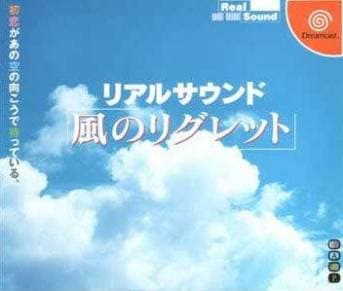
Real Sound first appeared on the Sega Saturn in Japan in July 1997, then came to the Dreamcast in March 1999.[1] The later Dreamcast version added an optional visual mode, but its still pictures were non-essential.[1] The important choice had already been made on the Saturn: the main version of the game did not make blind players accept a lesser copy of a sighted player’s experience.
The most repeated part of the game’s afterlife is not a scene from the plot, but a distribution story. Eno arranged for 1,000 consoles with the game to be sent to blind people, turning the accessibility idea into boxes, discs, and hardware in actual homes.[1] In the usual history of 1990s consoles, the machine under the television was a delivery system for spectacle. Here, the picture did not have to matter.
The game is still cataloged as a 1997 Sega Saturn adventure and audio game, developed and published by Warp in Japan.[2] Its strangeness is easy to describe and hard to improve on: a television on, a screen left blank, a chime sounding at the moment a choice has to be made.