About six weeks after the net went up, George Murray fell. High winds had sent a steel-carrying “traveler” into Murray and another worker, Ulysses Brown, on the Golden Gate Bridge job. Brown stayed on the bridge with a broken leg. Murray dropped into the rope net below, badly injuring both arms, then spent months recovering in a hospital.[1]
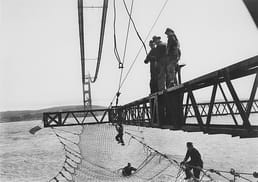
Joseph Strauss, chief engineer of the Golden Gate Bridge, insisted on a safety net beneath the bridge during construction. The $130,000 manila-rope net was considered extravagant, but it caught 19 falling workers who became known as the “Halfway to Hell Club.”
The bridge was built from January 5, 1933, to May 27, 1937, across the Golden Gate Strait, with crews working high above the water during the Great Depression.[2] The net hung beneath the roadway construction area, where a missed step, a gust, or a moving piece of steel could turn a workday into a fall.
On big construction jobs of that period, death was often treated almost like a line item. A common rule of thumb expected one fatality for every million dollars spent. Since the Golden Gate Bridge was estimated at $35 million, that grim arithmetic predicted 35 dead workers before completion.[3]
Strauss did not accept that as the price of the bridge. In a 1937 Saturday Evening Post article, he said he wanted to “cheat death by using every known safety device” for workers on the project.[3] The most famous of those devices was the net, a piece of equipment many people thought cost too much.
The net cost $130,000, an amount later estimated at more than $2.7 million in modern money.[2] It was made of manila rope and stretched beneath the bridge floor, extending 10 feet out from the trusses on both sides so it could catch workers who fell away from the steel instead of straight down.[2]
For the men above it, the net changed the feel of the job. The work still involved fog, wind, heavy materials, open heights, and dangerous machinery, but crews were no longer working over empty air alone. Accounts credit the net with improving morale and productivity because workers felt more secure at height.[2]
Strauss’s safety program also included hard hats, respirator helmets, eye protection, skin creams for harsh winds, and safety lines.[3] Another account notes that workers wore “hard-boiled hats,” early versions of modern hard hats.[1] This was decades before the Occupational Safety and Health Act was signed in 1970.[3]
The record was impressive for its time, though the job was not spared tragedy. Some accounts place total construction deaths between 11 and 17, while others give 11 for the entire project.[2][3] Either figure was far below the 35 deaths predicted by the old industry expectation.
The worst accident came when a five-ton scaffolding platform collapsed and tore through the net. Ten workers died in that single incident.[2] The disaster showed the limit of Strauss’s system. A net could catch a man. It could not always stop a falling mass of timber and steel.
The 19 workers it did catch became known as the “Halfway to Hell Club.”[2] The name was macabre, but it made the argument better than any safety lecture could. These were men who had fallen from the bridge and lived to tell people what had caught them.
Strauss was born in Cincinnati in 1870, trained as a civil engineer at the University of Cincinnati, and became known for bascule bridge design before serving as chief engineer of the Golden Gate Bridge.[4] The official bridge history describes him as the project’s leading force, a promoter, coordinator, manager, and construction leader who worked with engineers, architects, geologists, contractors, and laborers to bring the span into being.[5]
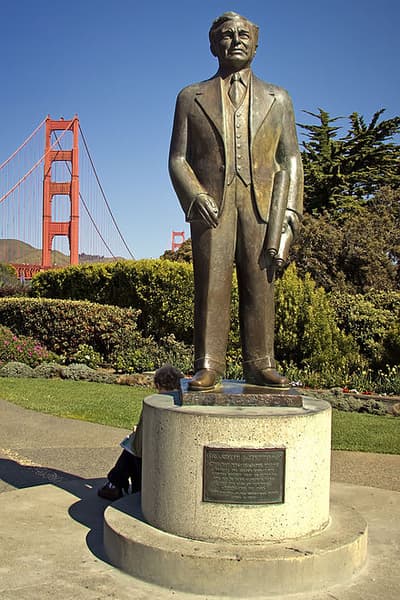
He died in Los Angeles in 1938, one year after the bridge opened.[4] On the San Francisco side, his memorial remains near the bridge. Beneath the famous towers and cables is the quieter image that helped change the job: a manila-rope net, stretched under unfinished steel, waiting for the next fall.
Sources
- When In Your State, “The men who built the Golden Gate Bridge had a club you could only join by almost dying”
- Vintage News Daily, “Views of the Safety Net Used to Protect Workers During Construction of the Golden Gate Bridge in the 1930s”
- SelectView, “Joseph B. Strauss, an Early Safety Pioneer who Built a Bridge”
- Wikipedia, “Joseph Strauss (engineer)”
- Golden Gate Bridge, Highway and Transportation District, “Joseph Strauss”