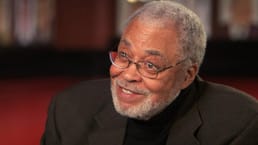
In Sunday school, James Earl Jones tried to read his lesson while the children behind him fell on the floor laughing. Years later, he called stuttering painful, and he was not speaking in metaphor. The pain was a word stuck in his mouth while a room full of children waited for it.[1]
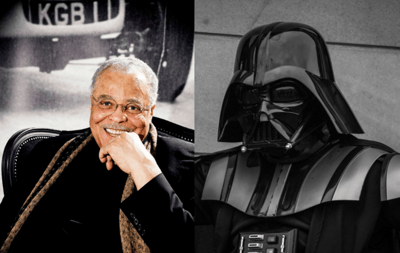
James Earl Jones, later famous as the voice of Darth Vader and Mufasa, spent much of his childhood barely speaking because of a severe stutter. In high school, a teacher helped him return to speech by having him read his own poetry aloud.
Jones was five when he moved from Mississippi to Michigan in 1936 to live with his grandparents.[1] He later told the Academy of Achievement that by the time he reached Michigan, “I was a stutterer. I couldn’t talk.” His first year of school became, in his words, his “first mute year,” and those mute years continued until high school.[1]
The move itself stayed with him. The BBC reported that when relatives tried to take him to his grandmother’s house, he clung to the car because, as he later recalled, “It was the only way I could express that I wanted to be with them.” The trauma, he said, was tied to the stammer that lasted into his teens.[2]
School made the problem public. A lesson read aloud, a question answered, a child’s name called from a roll book, each could turn speech into an ordeal. Jones said that by the time he reached Michigan, the stutter had become so severe that he stopped speaking for years.[1]
The Teacher Who Heard the Poem
In high school, one teacher noticed that Jones wrote poetry. Instead of leaving the poems safely on the page, the teacher encouraged him to stand in class and read his own work aloud.[2]
The words behaved differently when they were his, and when he had them in memory. Jones found that his stammer eased when he spoke memorized text.[2] The return of his voice was not sudden or simple. It came through rhythm, repetition, and the peculiar safety of words already known before they had to be spoken.
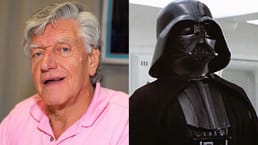
After that, Jones began taking part in debates and public speaking competitions.[2] The detail can sound impossible if the story begins with Darth Vader, the black helmet, the mechanical breath, and a voice so controlled it seemed to come from the walls. The path to that sound passed first through a classroom, with a teenager reading poems one line at a time.
Jones did not describe himself as cured. “I’m still a stutterer,” he said in 1996. He explained that people who stutter often learn to work around difficult sounds, reaching for words they will not trip on, words that begin with a safer consonant.[1] His voice became famous, but it was also managed, shaped, and practiced.
From Silence to Cinema
Jones studied at the University of Michigan, served in the U.S. Army, and later pursued acting in New York.[3] On stage and screen, his voice became one of the most recognizable in American culture. He voiced Darth Vader in the original Star Wars trilogy, voiced Mufasa in Disney’s The Lion King, and delivered CNN’s grave, clipped “This is CNN.”[1][2]
His honors eventually included Tony Awards, Emmy Awards, a Grammy, and an honorary Academy Award for lifetime achievement in 2011.[3][1] The public record can make that career look inevitable, a great voice finding its proper stage. The stranger fact is that the voice first had to be coaxed back into ordinary use.
Behind Darth Vader’s command and Mufasa’s warmth sits a smaller scene: a high school student with poems in his hands, a teacher asking him to read, and a room quiet enough for the first words to get through.