On the evening of December 13, 1862, wounded United States soldiers lay in the fields below Marye’s Heights, close enough to the Sunken Road to hear the men behind the stone wall, but too exposed for ordinary help. The story preserved at Fredericksburg says a young Confederate sergeant climbed over that wall carrying water.[1]
Richard Rowland Kirkland, remembered as the “Angel of Marye’s Heights,” was a Confederate soldier said to have aided wounded Union soldiers after the Battle of Fredericksburg. His canteen became the center of a Civil War story about mercy, memory, and a battlefield briefly quiet enough for compassion.
Kirkland was born in August 1843 in Kershaw County, South Carolina, the fifth son of Mary and John Kirkland.[2] He enlisted in the Confederate Army in 1861 while still a teenager, serving in the 2nd South Carolina Volunteer Infantry, first in Company E and later in Company G, where he rose to sergeant.[2]
Before Fredericksburg, his regiment had already carried him through First Bull Run, Savage’s Station, Maryland Heights, and Antietam.[2] Fredericksburg gave him a different kind of place in the record, not for a charge or a promotion, but for the reported act that later attached his name to Marye’s Heights.
The Wall, the Wounded, and the Water
Confederate troops at Fredericksburg held a strong position along the Sunken Road and the stone wall below Marye’s Heights. On December 13, 1862, repeated Union assaults failed against that line, leaving hundreds of wounded soldiers in the open ground in front of it.[1] The National Park Service describes Kirkland as crossing the wall under cover of darkness to distribute water to wounded enemy soldiers.[1]
In the familiar retelling, the scene becomes stark and almost still: a Confederate soldier moving among men his army had just fought, giving water where it was needed rather than where allegiance made it easy. Later accounts helped fix Kirkland in public memory as the “Angel of Marye’s Heights,” a name that appears with his biography and with the monument at Fredericksburg.[2]
The story has endured because it holds two facts together without making either one disappear. Kirkland fought for the Confederacy. The men he is said to have helped were Union soldiers. The act remembered at the Sunken Road does not change the cause he served, but it records a moment when a battlefield made room for mercy.
A Story Tested by Time
The National Park Service treats the Kirkland story with care, noting that questions about fact and legend have surrounded it for a long time.[1] Stories of Confederate soldiers aiding wounded Union men circulated soon after the battle. A few weeks later, Walt Whitman, volunteering in a Union hospital, recorded a wounded U.S. soldier describing Confederate good Samaritans who crossed the lines to help the wounded.[1]
Kirkland’s name entered the account later. In 1870, James Hagood wrote of a soldier in Kershaw’s brigade who went over the wall to assist Union wounded.[1] In 1880, newspaper editor Carlyle McKinley asked Confederate General Joseph Kershaw to identify the man. Kershaw named Richard Kirkland and wrote the version that became the best-known telling.[1]
The Park Service says there is little reason to doubt Kershaw’s identification, since Kershaw and Kirkland were not related or closely connected, and at least five other members of the 2nd South Carolina later also named Kirkland.[1] At the same time, Kershaw’s account includes dialogue and precise details that seem unlikely to have been remembered exactly more than 20 years after the event.[1]
The Angel Who Did Not Survive
Kirkland’s life after Fredericksburg was brief. He continued to serve, was promoted to second lieutenant, and fought in later engagements including Chancellorsville and Gettysburg.[2] On September 20, 1863, he was killed at the Battle of Chickamauga. He was 20 years old.[2]
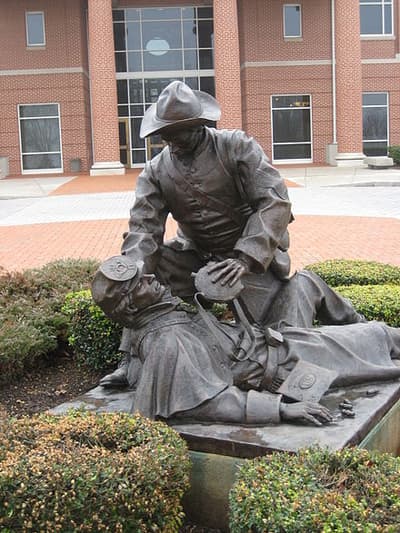
Today, the Kirkland Memorial stands near the Sunken Road in Fredericksburg, on land once associated with the Ebert House and later saved from development by the University of Mary Washington.[1] Atlas Obscura describes the monument as honoring a Civil War soldier who braved the battlefield to give water to dying enemies.[3] The statue leaves him in the posture the story chose to keep: bent toward a wounded man, canteen in hand, beside the stone wall.