Late on April 26, 1777, a tired messenger reached Colonel Henry Ludington’s house near the New York and Connecticut border with news from Danbury. British troops had entered the Connecticut town, found Patriot military stores, destroyed supplies, looted buildings, and set fires that could be seen for miles.[1]
Sybil Ludington is remembered as the 16-year-old who, according to family accounts and later histories, rode about 40 miles through the night to alert her father’s militia after the British raid on Danbury, a route often described as more than twice Paul Revere’s ride.
Henry Ludington had a regiment on paper, but not in the yard. The Dutchess County militia he commanded, roughly 400 men, had been scattered around the countryside on furlough.[1] Ludington had served in the French and Indian War, owned a gristmill, and was positioned just across the line from Connecticut, but that night his authority depended on reaching farmhouses in the dark.[1]
The messenger who brought the alarm had already spent himself getting to Ludington’s door.[6] In the traditional telling, Sybil, the colonel’s oldest daughter, either volunteered or was sent out around 9 p.m. into rain and rough country roads.[1] She had turned 16 earlier that month.[2] Later accounts place her route through places such as Carmel, Mahopac, and Stormville, calling out for the men to gather at Ludington’s because the British were burning Danbury.[6]
By daybreak, the story says, she had covered nearly 40 miles and returned home after rousing the militia.[1] The comparison with Paul Revere came easily, partly because Revere’s ride was shorter, and partly because Americans have always liked a midnight warning shouted from horseback. One version says Sybil drove off a highwayman with her father’s musket; another gives her a stick instead.[1][6] The changing weapon is a small warning of its own, because Ludington’s ride survives in later retellings, not in a neat packet of 1777 documents.
The burning of Danbury
Danbury mattered because it held supplies for the Patriot cause. Accounts describe British forces destroying food, shoes, grain, tents, and other stores, while also burning Patriot houses and public buildings.[6] The raid pulled American forces toward Ridgefield, Connecticut, where fighting followed the next day.[4]
At Ridgefield, General David Wooster was killed, and Benedict Arnold, still fighting for the Revolution, had his horse shot from under him.[4] Colonel Ludington’s men arrived too late to save Danbury, but later accounts credit the mustered militia with helping harass the British as they withdrew.[1] Afterward, Alexander Hamilton wrote to Colonel Ludington that the stores destroyed at Danbury had been purchased at a “pretty high price” by the enemy.[1]
The most famous thank-you in Sybil’s story came from higher up the Revolutionary chain. Traditional accounts say she received personal thanks from General George Washington and from General Rochambeau, the French commander who fought with the Americans.[1] That detail helped turn a local family story into the image of a teenage Revolutionary heroine.
The problem with the legend
No known official record from 1777 proves Sybil Ludington made the ride. Printed accounts appeared much later, first in an 1880 local history and then in a 1907 publication connected to her father’s memoirs.[2] Smithsonian Magazine notes that even basic details shift, including the spelling of her name and whether her horse had a name at all.[4]
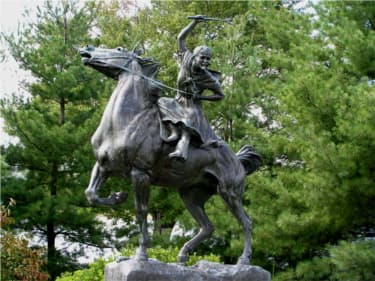
In the 20th century, the story grew larger. New York road markers, books, statues, and a 1975 United States Bicentennial postage stamp carried Ludington’s name well beyond Putnam County.[2] In Carmel, New York, a statue by Anna Hyatt Huntington shows her on horseback, and its plaque describes a 16-year-old girl riding alone through the night to alert the countryside to the burning of Danbury.[1]
Sybil Ludington later married Edmond Ogden, had a son named Henry, and died in 1839, just short of her 78th birthday.[1][2] What remains is both history and argument: a dark road, a burning town somewhere beyond the trees, and a girl remembered for carrying the alarm from one farmhouse to the next.
Sources
- Revolutionary War, “Sybil Ludington”
- Wikipedia, “Sybil Ludington”
- HISTORY, “Who Was The Teen Girl Known as the ‘Female Paul Revere?’”
- Smithsonian Magazine, “Did the Midnight Ride of Sibyl Ludington Ever Happen?”
- TheCollector, “Sybil Ludington: The Girl Who Rode Twice As Far As Paul Revere?”
- New England Historical Society, “At Half His Age, Sybil Ludington Rode Twice as Far as Paul Revere”