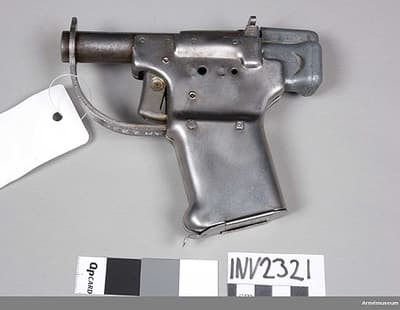
In the box, the weapon looked less like a soldier's sidearm than a stamped-metal prop from a bad spy picture. A crude pistol. Ten .45 cartridges. A small wooden stick. A wordless instruction sheet drawn like a comic strip, so the person opening it could learn the mechanism without reading English.[2][3]
The FP-45 Liberator was a $2.10 single-shot pistol made by the United States in World War II for resistance fighters in occupied territory. It was cheap enough to scatter by air, simple enough to explain in pictures, and meant for one close-range shot before seizing a better weapon.
The official name was deliberately dull: Flare Projector Caliber .45, or FP-45. The disguise went deeper than the label. On engineering drawings, the barrel became a "tube," the trigger a "yoke," the firing pin a "control rod," and the trigger guard a "spanner."[1] Even the paperwork tried not to admit that the United States was mass-producing a pistol for people behind enemy lines.
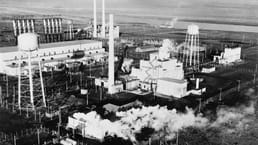
The idea appeared in March 1942, suggested by a Polish military attaché, then taken up by the U.S. Army Joint Psychological Warfare Committee.[1][4] George Hyde designed the weapon for the Army, and production went to General Motors' Guide Lamp Division in Anderson, Indiana.[1] Guide Lamp was not known for fine pistols. It knew stamped metal, high-speed production, and factory repetition, which was exactly what the job required.
By firearms standards, the Liberator was almost aggressively plain. It weighed about one pound, measured 5.55 inches long, fired a .45 ACP cartridge, and held only one round at a time.[1] There was no magazine. Its effective range was listed at about 8 yards.[1] One account noted that the pistol could be manufactured faster than it could be loaded.[3]
A Weapon Built for the First Shot
The plan behind the Liberator was brutal and narrow. A resistance fighter was not supposed to carry it into a firefight. He was supposed to get close, use the single shot against an occupier, then take the soldier's better weapon and equipment.[2][3] The pistol was a key for one door, provided the user survived long enough to turn it.
American planners also treated the little gun as a psychological weapon. Scattering cheap pistols across occupied territory might do more than arm insurgents. It could make occupying troops uneasy, forcing them to imagine a gun in every barn, ditch, or coat pocket.[3][4] A disposable-looking pistol could still become expensive to an army trying to feel secure.
The manufacturing numbers were enormous. About one million FP-45 pistols were built in 1942, at a unit cost of $2.10.[1] One historical account says roughly 300 workers produced the run in eleven weeks, turning out a 23-part pistol every 6.6 seconds around the clock.[3] Each was packed in a paraffin-coated cardboard box with ammunition, the wooden stick, and the pictorial sheet.[2][3]
Its wartime career was murkier than its production line. The Liberator was never issued to American or other Allied troops, and there are few documented cases of it being used exactly as intended.[1] That absence is partly built into the subject. Resistance fighters and irregulars had strong reasons not to keep written records that could be captured by the enemy.[1] Sources disagree on the scale of European drops, while evidence points more strongly to use by guerrillas in the Philippines and some distribution through the OSS.[2][3]
After the war, the little pistol became almost as disposable as its designers had imagined. Few were distributed as planned, and most were destroyed by Allied forces.[1] Other accounts describe hundreds of thousands dumped, melted, or scrapped, which helped make surviving examples scarce collector's pieces.[2][3] The comic-strip instruction sheet and original cardboard box can be rarer than the gun itself.[3]
The Liberator remains a strange artifact of industrial war: a million cheap pistols built for one frightened person in occupied territory, opening a waxed box and finding, beside ten cartridges and a slip of drawings, a single chance.