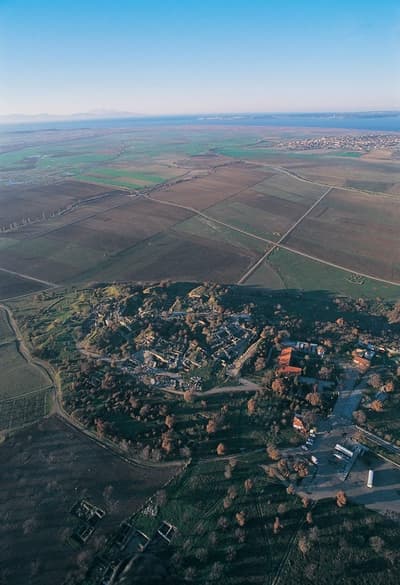
At Hisarlik, the past rose from the ground as a mound near Tevfikiye, outside Çanakkale. One ruined city sat above another, packed together like pages pressed shut. When Heinrich Schliemann excavated there in the 1870s, he was chasing a place that poetry had kept alive for centuries: Troy, the city of Priam, Helen, Achilles, and the war Homer sang about.[1][2][3]
Troy was long treated by many as a legendary city from Homer, but excavations at Hisarlik in modern Turkey revealed a real, many-layered ancient settlement. The surprise was not one buried Troy, but a stack of Troys, rebuilt again and again over thousands of years.
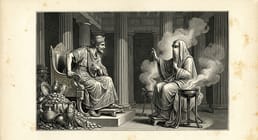
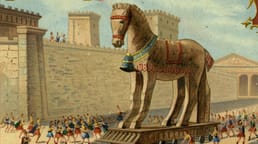
Homer’s Iliad gave the city its cast: Helen, Paris, Agamemnon, Priam, a ten-year siege, and a wooden horse that carried Greek soldiers through the gates. For many readers and scholars, that made Troy feel less like a place on a map than a brilliant literary inheritance, mixed with gods, heroes, and impossible scale.[2][4]
Schliemann chose a real landscape, not a stage set. Hisarlik sits in northwestern Turkey, near the Dardanelles, the narrow passage connecting the Aegean Sea with the Sea of Marmara. That position helps explain why people would have cared about the site long before tourists arrived with cameras and guidebooks.[3][5]
The Mound With More Than One Troy
Excavation turned the old question sideways. The issue was no longer only whether Troy had existed. Archaeologists found major settlement layers, commonly labeled Troy I through Troy IX, showing that the mound held a sequence of cities built, damaged, abandoned, rebuilt, and reused across a long span of history.[2][4][5]
Early Bronze Age levels lay beneath later fortifications, gates, homes, temples, roads, and public buildings. One community became the foundation for the next. The famous city had been hidden partly because later people kept living, building, and remembering on top of earlier Troy.[3][5]
Schliemann thought he had found Homer’s Troy in an early level called Troy II. He also uncovered a treasure hoard that he named “Priam’s Treasure,” linking it to the legendary king. Later research made that identification difficult, since the hoard appears to be about a thousand years older than the likely period of any Trojan War.[2][3]
The mistake did not empty the mound of meaning. It made the site stranger and richer. Troy was not a single heroic snapshot waiting under the soil. It was a long record of settlement at a strategic crossroads, important enough that people returned to the same ground again and again.[4][5]
Which Layer Belonged to the Legend?
Later archaeologists paid closer attention to Troy VI and Troy VII, the Late Bronze Age layers often discussed as stronger candidates for the city behind the Trojan War tradition. Those levels fall nearer the period when such a conflict, if historical, may have taken place.[2][3][5]
Troy VII has drawn particular interest because some scholars connect it with destruction around the era traditionally associated with the war. The evidence does not make Homer a reporter, and no wooden horse has emerged from the earth. It does show that a real fortified city stood in the region where the legend placed one.[3][5]
The later city kept adding to the stack. In Greek and Roman periods, Troy became a place of memory, religion, and prestige. Roman Troy, known as Troy IX, had temples, theaters, and roads, while the older layers remained part of the site’s identity.[4][5]
In 1998, the archaeological site of Troy was named a UNESCO World Heritage Site.[4] Visitors today can walk past ancient stone walls and stand near a symbolic wooden horse at the entrance, looking at a mound where legend survived because people had kept building over the buried city beneath their feet.[3]