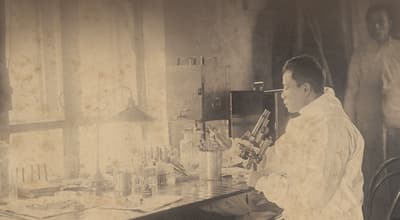
On Christmas Eve in 1910, Wu Lien-Teh stepped off a train in Harbin with a microscope in his luggage. The 32-year-old doctor had been sent into a city where people were vomiting blood, dying by the dozens, and carrying the disease along the railway lines of northeast China.[1]
During the 1910 Manchurian plague, Dr. Wu Lien-Teh identified the outbreak as pneumonic plague, spread through the air, and pushed masks, quarantine, and cremation. Gérald Mesny, a French doctor who rejected Wu’s diagnosis, entered a plague ward without a mask and died six days later.
Two months earlier, two fur traders returning from Russia had died at an inn in Manzhouli. Within 10 days, the sickness had reached Harbin. The new railway, completed with Russian assistance only a few years before, helped turn a frontier outbreak into a regional disaster across Heilongjiang, Jilin, and Liaoning.[1]
The first explanation was familiar: bubonic plague, the rat-and-flea disease that had terrified cities for centuries. But Japanese investigators in Harbin had dissected hundreds of rats and found no sign of the plague organism in them.[1] Wu was working in a place where medicine and empire overlapped. Russia and Japan had doctors on the ground and ambitions in Manchuria, while the Qing government needed its own answer before the epidemic became another argument for foreign control.[1]
On December 27, after a Harbin hostel owner died, Wu asked to examine the body. Autopsies were culturally taboo and legally dangerous in China at the time, so he obtained the family’s approval and worked secretly in the hostel. Under the microscope, he found Yersinia pestis, the plague bacterium.[1]
The dead hostel owner gave Wu the evidence for a more frightening diagnosis. The disease was passing from person to person through the lungs. Wu concluded that Manchuria was facing pneumonic plague, an airborne form of the disease so lethal that confirmed cases often ended in death.[1]
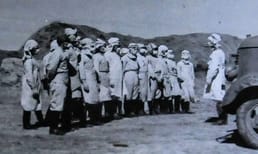
That diagnosis led to a simple object with enormous consequences: the mask. Wu promoted cloth face coverings for doctors, nurses, patients, contacts, and as much of the public as officials could reach.[2] He also pushed quarantine, travel controls, and the isolation of suspected cases. In Harbin, railway wagons were used as isolation camps during plague times, a grim improvisation preserved in photographs from Wu’s plague albums.[3]
Not everyone accepted the young Penang-born, Cambridge-trained doctor’s conclusion. The Qing government sent Gérald Mesny, a French physician with plague experience, to Harbin in January 1911. Mesny rejected Wu’s airborne theory and, according to accounts of the episode, insulted Wu with a racial slur while insisting the outbreak was bubonic plague.[1]
Mesny then tried to prove his confidence with his body. He toured a plague ward without wearing a mask. Six days later, he was dead.[1]
Wu’s measures were severe because the epidemic was severe. The Manchurian plague of 1910 to 1911 ultimately killed an estimated 60,000 people in Manchuria and Mongolia.[2] In Harbin’s Fujiadian district, corpses accumulated faster than ordinary burial could handle. Wu secured permission for mass cremations, a painful break with custom but a practical answer to infected bodies waiting in the cold.[1] One surviving image from February 20, 1911, shows 176 coffins of Roman Catholic plague victims being cremated in Fuchiatien under Wu’s personal supervision.[3]
By the time the outbreak was brought under control, Wu had helped establish a pattern later epidemics would recognize: identify the pathogen, interrupt movement, isolate the exposed, protect the lungs, and tell the public what is happening. The Manchurian response has been described as a precedent for multinational epidemic control and for organized protective equipment in outbreaks.[2]
The object left at the center of the story was small enough to fold into a pocket. In Harbin, after the microscope slide and the secret autopsy, a strip of cloth over the mouth and nose became the line between one diagnosis and another.