
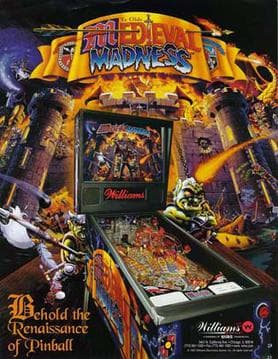
The castle in Medieval Madness does not simply wait for the ball. A shot pounds the entryway, the drawbridge drops, the portcullis rises, lights flare, and the dot matrix display stages an explosion as if a tiny siege has worked under glass.[1] Inside that 1997 Williams cabinet, Tina Fey was waiting too, not on a television set, but as a pinball princess.
Before 30 Rock, Tina Fey was one of the voices in the 1997 Williams pinball machine Medieval Madness, supplying princess dialogue while future co-star Scott Adsit contributed dialogue and voice work to the game.
Williams released Medieval Madness in June 1997, with Brian Eddy designing the machine and Lyman Sheats programming it.[1] The main task was wonderfully blunt: destroy six castles. Players battered the castle entrance with a steel ball until the drawbridge lowered, the portcullis lifted, and a final shot into the castle triggered the game’s little burst of destruction.[1]
Dan Forden handled the music and sound, but the cabinet’s comedy came from a crowded voice list that included Tina Fey, Scott Adsit, Andrea Farrell, Greg Freres, Vince Pontarelli, and Kevin Dorff.[1] Much of the dialogue was written by Adsit and Dorff, and Adsit also performed voices for the game.[1] Years before Fey and Adsit appeared together on 30 Rock, their names were already sharing space in a medieval pinball world of trolls, knights, princesses, and taunting arcade speech.
The Comedy Was Built Into the Cabinet
The cast list reads like a backstage sheet that somehow got bolted into an arcade machine. Fey and Andrea Farrell voiced the princesses, including one with a “valley girl” accent.[1] Freres voiced the jousting announcer and one of the trolls, Pontarelli voiced Francois Du Grimm and the other troll, while Adsit and Dorff handled the remaining male voices, including knights and the Wizard.[1]
The “valley girl” princess was a very specific kind of joke. By the 1980s and 1990s, the Valley girl had become a familiar American stock character associated with the San Fernando Valley, youth slang, and a pop-culture image of stylish, unserious confidence.[3] The 1983 film Valley Girl, starring Deborah Foreman and Nicolas Cage, had helped carry the type into mainstream romantic comedy.[2] Even a modern streaming description of the movie leans into the language, saying Julie’s friends find her new love “grody to the max.”[4]
So Medieval Madness did not just spoof castles. It crashed centuries together. The playfield had a moat, a drawbridge, jousting, trolls, and a wizard, then dropped a late-twentieth-century California caricature into the tower. The damsel in distress sounded as if she had wandered in from the mall.
A Small Run With a Long Afterlife
Only 4,016 units of the original 1997 edition were produced.[1] The machine became one of the most admired modern pinball games, with many casual players considering it the greatest pinball machine.[1] Its reputation lasted long enough that Chicago Gaming began releasing remake versions in 2015 under license from Planetary Pinball, which holds the Williams pinball manufacturing and parts rights.[1]
The original flyer promised, “Behold the Renaissance of Pinball,” a grand line for a business hoping for revival.[1] What remains more intimate is the cabinet itself: steel smacking the castle gate, plastic towers shaking, lights flashing, and Tina Fey tucked into the circuitry as a princess with a punchline.