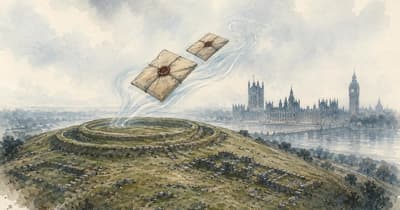
For centuries, Britain let an almost empty hill send two members to Parliament. The place was Old Sarum, a windswept site outside modern Salisbury that had once been a real center of power, then somehow kept its political clout long after most of its people were gone.[1][2][3]
That is what makes the story feel less like history than satire. Old Sarum had been important in several different lives: first as an Iron Age hillfort, then as a Norman castle and cathedral complex, and for a time as a serious administrative center in southern England.[2][3] But once the cathedral moved to nearby Salisbury in the 1220s, the old site faded. Stone was quarried away, the settlement thinned out, and the hill slowly turned into a shell of itself.[1][2][3]
The parliamentary seat, however, stayed weirdly healthy. Old Sarum kept the right to elect two MPs until the Reform Act of 1832, despite having no meaningful population left.[1][4] Britannica notes that rotten boroughs like this were among the clearest scandals of the unreformed system, with tiny electorates giving aristocratic patrons wildly disproportionate power in the House of Commons.[4]
Old Sarum was one of the most notorious examples because its voting rights were tied to burgage plots. In practice, that meant control of the land meant control of the seats.[1] By the final election in 1831, there were only eleven voters, and none of them actually lived there.[1] That is less democracy than property management in ceremonial clothing.
The best detail is how faithfully the ritual survived after the town did not. According to the constituency record, an election in 1802 was held in a temporary booth set up in a cornfield under a tree marking the old boundary.[1] Officials read out the legal formalities, called three times for more nominations, and then declared the chosen men elected.[1] Imagine voting in a field for a town that had effectively vanished, while everyone involved pretended this was normal constitutional life.
Old Sarum became such a potent symbol because it compressed the whole absurdity into one picture: empty land, real power.[1][4] The site had once helped kings and bishops run a region.[2][3] Long after that importance was gone, it still helped patrons slip friendly men into Parliament.[1][4]
That is why the fact still lands now. Political systems do not stop being broken just because everybody can see the break. Sometimes the forms remain tidy, the ritual survives, and the absurdity hardens into custom. Old Sarum gave reformers a perfect example. If an abandoned hill could choose two lawmakers, the problem was not a few creaks. The whole machine was warped.[1][2][4]