Uriah Smith knew what a frightened horse could do to a street. In 1899, in Battle Creek, Michigan, he filed a patent for a motor vehicle body with one startling addition: a life size horse head projecting from the front of the machine.[1]
The Horsey Horseless was a proposed 1899 automobile design by preacher and inventor Uriah Smith. Its fake horse head was meant to make passing horses think the new motorcar was only another horse drawn vehicle.
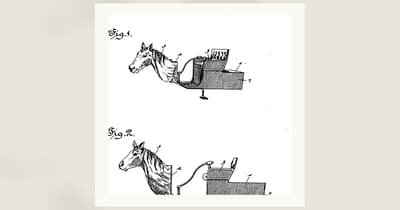
Patent No. 30,551 called the shape both "useful and ornamental," then gave the useful part in a sentence that still feels like mechanical theater. A live horse, Smith wrote, would think it was seeing another horse, and before it could discover the error, the strange carriage would already have passed.[1]
On the drawing, the vehicle body is boxy and ordinary for the period. Out front, where a radiator or lamp might later belong, a horse's neck rises in a fixed curve. Consumer Guide notes that the head was supposed to be life size and fastened ahead of the carriage, with Smith also recommending the hollow figure as a wind brake and a gasoline receptacle.[2]
Roads in the 1890s still belonged to animals as much as machines. Autoweek points out that Smith was imagining a world with very few automobiles and far more horses, a world where the new object on the road was the one that needed explaining.[3] The fake head was aimed at more than the horse. It promised everyone nearby that the future could be made to wear a familiar face.
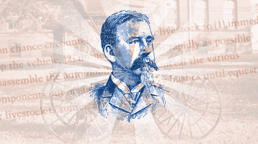
Smith came to the car problem from outside the factory floor. He was a Seventh-day Adventist preacher, teacher, writer, and illustrator, and Autoweek notes that he had already patented an articulated prosthetic leg after losing one of his own to infection.[3] The Horsey Horseless came from the same practical imagination, the impulse to answer a bodily problem with a visible device.
The surviving trail is a patent drawing, a few clipped descriptions, and a name that sounds as if it escaped from a children's book. Field Office's discussion of the design places it at a moment when new machines often borrowed the shapes of the things they were replacing.[4] Early automobiles already looked like carriages with the horses removed. Smith's version put the horse back, at least as a mask.
A gasoline tank shaped like a horse head is hard to defend with a straight face. The human part is gentler. People rarely meet a new technology on its own terms the first time. They ask it to look like the old habit, the old tool, the old animal in the lane. Smith's patent leaves us with a car trying to pass quietly through a horse's world, wearing the face of the creature it was about to replace.