Judith Love Cohen carried an engineering printout to the hospital while she was in labor. The problem on the paper still needed solving. According to the family story preserved in the legacy account, she worked it through, called her boss to say it was finished, and then gave birth to the child who would grow up to be Jack Black.
Judith Love Cohen was an aerospace engineer whose work touched Pioneer, Apollo, and Hubble, including the Abort-Guidance System credited by her family with helping bring Apollo 13 home safely. She was also Jack Black’s mother, but that is only the strangest doorway into a much larger life.
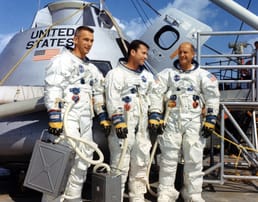
Her son Neil Siegel, writing after her death in 2016, said Cohen usually considered the Apollo program the highlight of her career. When Apollo 13 was crippled in space, he wrote, “it was the Abort-Guidance System that brought the astronauts home safely.” Later, the Apollo 13 astronauts visited the TRW facility in Redondo Beach to thank the people who had helped make that return possible, and Cohen was there.[1]
The famous movie version of Apollo 13 tends to leave viewers with faces in Mission Control, frantic calculations, and a spacecraft becoming a lifeboat. Cohen’s story points to a quieter part of the rescue, the years of systems work done before anyone knew which switch, circuit, or guidance path might matter. By the time the emergency arrived, the machinery of survival had already been designed, argued over, tested, and revised by engineers whose names rarely travel with the astronauts’ names.
A Career Built Around Machines That Had To Work
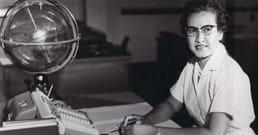
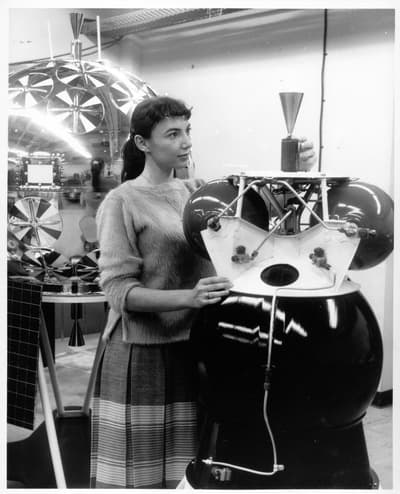
Cohen’s engineering career crossed some of the most recognizable hardware in American spaceflight. She worked on Pioneer, Apollo, and Hubble missions, and she was photographed with an early Pioneer spacecraft in 1959.[1] She later finished her engineering career running systems engineering for the science ground facility of the Hubble Space Telescope.[1]
That range matters because it shows the scale of the work. Pioneer meant sending machines outward. Apollo meant navigating humans through danger. Hubble meant building the ground systems for one of the most important scientific instruments ever placed above the atmosphere. Cohen’s name is often rediscovered because of her famous son, but the record keeps pulling the eye back to consoles, spacecraft, job descriptions, and rooms full of engineers.
She had also been a ballet dancer with the New York Metropolitan Opera Ballet Company, according to the account collected by Kottke, and later became an author and publisher.[1] The shape of the life is almost absurdly compressed: ballet, spacecraft, workplace reform, children’s books, Apollo 13, Hubble, Jack Black. Any one of those could have made a biographical footnote. Together, they make the usual “mother of a celebrity” label feel badly underbuilt.
The Problem She Kept Solving After Engineering
During her engineering career, Siegel wrote, Cohen pushed hard for better treatment of women in the workplace. He credited her with helping create practices that now sound ordinary, such as posting job openings inside a company so anyone could apply, and writing formal job descriptions for positions.[1] Those are dry office mechanisms until you imagine the alternative: opportunity moving quietly through closed networks, with women learning too late that a door had existed.
After retiring from engineering, Cohen turned to another missing system. She was frustrated by the lack of female role models for girls interested in science, math, and technology, so she wrote and published books about women in STEM and environmentalism.[1] A 1999 Los Angeles Times profile, quoted by Kottke, described an 11-book series featuring female professionals such as a paleontologist, an Egyptologist, and a marine biologist.[1]
Her first book, published in 1991, was called You Can Be a Woman Engineer. It traced her path from a girl who had never heard of female engineers to a woman who led a team of engineers on the design for NASA’s Hubble Space Telescope, according to the profile excerpt.[1] Cohen explained the problem plainly: girls could picture lawyers because they saw women lawyers on television and in the news, but scientists remained largely invisible.[1]
The hospital printout is the part people repeat because it is cinematic: a woman in labor, an unfinished technical problem, a phone call to the boss, a baby who becomes a movie star. But the more lasting image may be Cohen standing beside early spacecraft, then later putting women scientists into books so a girl would not have to invent the possibility from scratch.