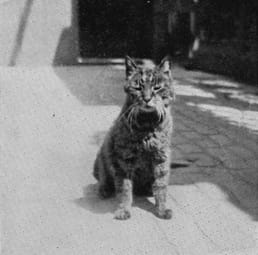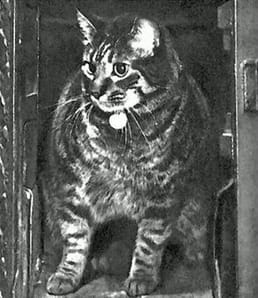
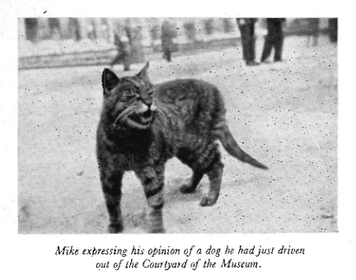
In the spring of 1908, Black Jack, the British Museum’s house cat, walked up to E. A. Wallis Budge, Keeper of Egyptian antiquities, with a large object in his mouth. He set it down at Budge’s feet. The bundle turned out to be a kitten, soon known around the museum as Mike.[1]
Mike the cat became the British Museum’s unofficial gatekeeper for about 20 years, known for patrolling the entrance, chasing off dogs, accepting food from only certain people, and becoming famous enough that Time magazine covered his death twice.
The next year, according to the account preserved about him, Mike began learning the museum trade from Black Jack. The older cat taught him to stalk pigeons in a strangely formal way, pointing like a dog while the younger cat moved in. Mike would corner a pigeon, daze it, and carry it to the housekeeper, who traded the bird for food and milk before releasing it unharmed.[1]
By February 1909, Mike had begun the work attached to his name: assisting in keeping the main gate of the British Museum.[1] The job title sounds comic because the employee was a cat, but the place itself made room for such a figure. The museum had scholars and antiquities, but it also had a portico, house staff, pigeons, stray dogs, visitors, and a front entrance where a watchful animal could become part of the daily machinery.
A Gatekeeper With Preferences
Mike stayed at the British Museum for roughly two decades. Over that time, reports turned him into a small public character, less a household pet than a creature with rules. He was known for avoiding women and disliking dogs. He accepted food only from people who, in the remembered phrase, treated him “as a man and brother.”[1]
In 1924, Mike retired from official duties, although retirement did not remove him from the scene. He still watched the comings and goings at the museum, and he still reacted strongly to wandering dogs. One account said the dogs “fled in terror” when Mike attacked.[1]
His reputation traveled farther than the gate. After Mike died in January 1929, Time magazine devoted two articles to him, and later described him as “probably the most famed British feline of the 20th Century.”[1] That is a large claim for an animal whose duties included sitting, watching, refusing affection, and enforcing invisible rules around a museum entrance.
The Portico Crowd
A 1927 article in the Star placed Mike in the middle of the British Museum’s human traffic. He was said to eye scholars, including “famous men from all countries,” with the same philosophical air he gave to ordinary curiosity seekers. The article’s list of visitors becomes a small street scene: high school girls in uniform, London street children using the portico as a playground, black-robed monks, sari-clad Hindu women, Japanese visitors, and horn-spectacled tourists.[1]
At the center of that crowd, Mike’s role was mostly to look. That was enough. A museum gate is a threshold between the city and the curated past, and Mike made the threshold feel staffed by a personality. Before visitors reached the Egyptian antiquities, labels, cases, and catalogues, they might first meet a cat with a sharp sense of who could approach, who could feed him, and which dogs needed removing.
When Mike died, Budge wrote an obituary for the Evening Standard. It became the basis for a small monograph with the wonderfully exact title Mike, the cat who assisted in keeping the main gate of the British Museum from February 1909 to January 1929.[1] The work has been described as a high point of its peculiar biographical form, the serious life of a very particular cat.[1]
The monograph included an ode by F. C. W. Hiley, whose surviving lines are affectionate and slightly bruised: “Old Mike! Farewell! We all regret you, Although, you would not let us pet you.”[1] It is a fitting image for Mike at the gate, mourned by people he had kept at a cat’s chosen distance.