In 1884, after five years of work, the great English dictionary finally produced something readers could hold: an unbound installment called a fascicle. Its alphabetic journey stopped at ant.[3]
The Oxford English Dictionary began in earnest in 1879 with a 10-year estimate, but its editors needed five years just to publish the first section, from “a” to “ant.” Help from readers and decades of editorial labor carried the first edition to completion in 1928.
In 1857, the Philological Society of London set out to gather English words that existing dictionaries had missed, reaching back toward Anglo-Saxon times.[3] The aim was larger than a list of definitions. The future OED would trace where words had appeared, how meanings had shifted, and how older uses survived beside newer ones.[1]
Oxford University Press agreed to finance and publish the work in 1879, when it was still called the New English Dictionary.[3] James Murray, a Scottish-born philologist who had left school at fourteen and educated himself in languages, became the project’s principal editor that same year.[4] Murray thought the dictionary might take about 10 years to compile.[3]
Five years later, the first printed fascicle showed how badly the alphabet had been underestimated. Murray and his assistants had reached only from “a” through “ant.”[3] The endpoint is comic because the word is so small. An ant looks like the kind of entry a dictionary should step over quickly. For the OED, even that little word had to be read for, dated, compared, defined, and placed inside a history of usage.
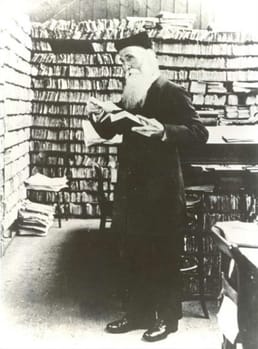
Murray’s operation eventually became known by its working place, the Scriptorium. At 78 Banbury Road in Oxford, the dictionary advanced through letters, slips, quotations, and in-house editorial labor.[5] Murray began as the sole editor, aided by a small team, before Henry Bradley, William Alexander Craigie, and Charles Talbut Onions joined as co-editors over the years.[5] Oxford’s own history of the dictionary also preserves the public-appeal side of the work, later summed up in the phrase “Your dictionary needs you.”[2]
The slow pace made sense once the job was understood as historical rather than merely alphabetical. A compact dictionary can tell a reader what a word means at the moment. The OED tried to give words biographies, including obsolete forms, changing meanings, and evidence from written use across time.[1] A single entry could become a miniature archive. The distance from a to ant became a warning about everything still waiting after it.
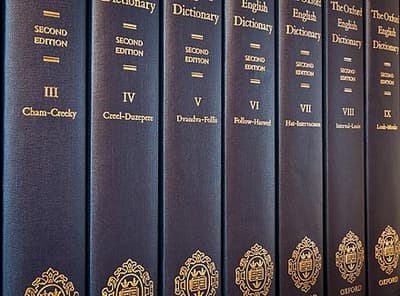
Murray did not live to see the last installment. He died in 1915, after serving as the OED’s primary editor from 1879 until his death.[4] The final fascicle appeared on April 19, 1928, nearly 50 years after Oxford University Press had taken the project on.[3] The first edition filled 12 volumes and 15,487 pages, covering 414,825 words, far beyond the early plan for four volumes and 6,400 pages.[3]
The dictionary kept expanding after that first finish line. OED Online launched in 2000, and the work continues to add new words and meanings; today it contains more than 600,000 entries.[3] Its size has become almost absurd in another way: Oxford’s publishers have estimated that one person would need about 120 years just to type the dictionary’s text.[1]
One later assistant gives the story a small literary afterimage. In 1919, a 27-year-old J.R.R. Tolkien joined the project and spent about 18 months working on words beginning with W, including “wasp” and “walnut.”[3] Long before Middle-earth, he was one more worker at the edge of the alphabet, helping move a giant book forward by a few more words.