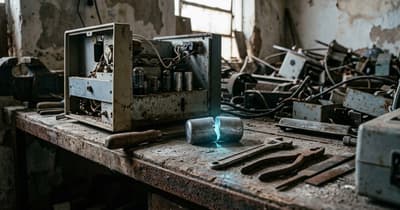
Devair Alves Ferreira later left his family with a sentence that sounds almost impossible until you know what was glowing in his junkyard. He had fallen in love with the shine of death. After broken metal from an abandoned radiotherapy machine reached his scrapyard in Goiânia, Brazil, he noticed that something inside it glowed blue in the dark. Friends and relatives came to look. Small fragments, some described in an official report as about the size of rice grains, were handed around from house to house.[1][2]
Brazil's Goiânia accident began when scrap dealers dismantled an abandoned medical radiation source and passed around glowing caesium-137 powder before anyone understood what it was.
On September 13, 1987, two men entered the partly demolished clinic where a private radiotherapy institute had left the machine behind. They removed the source assembly, carried it away, and tried to take it apart because the metal looked useful. The source capsule ruptured. The material inside was caesium chloride, a salt that could scatter easily once the capsule was broken.[1]
At the junkyard, the blue light made the danger feel almost domestic. The IAEA report says several people were fascinated by the glow, and that visitors came over a period of days to see it. Nobody had to believe in nuclear power or medicine or physics for the powder to become social. It became a thing you showed someone after dinner. It became a curiosity small enough to carry home.
Vomiting and diarrhea reached the exposed families before the radiation alarm did. The symptoms were not recognized at first as radiation exposure. Five days passed before one of the exposed people connected the illnesses with the source and took the remnants to the public health department. A local physicist then measured the radiation, evacuated contaminated areas, and alerted authorities to the scale of the accident.[1]
Officials eventually counted a trail far larger than a single junkyard. The IAEA counted about 112,000 people monitored, 249 people contaminated internally or externally, four deaths, and 28 people with radiation burns. Seven residences and other structures had to be demolished, soil was removed, and roughly 3,500 cubic meters of radioactive waste were generated.[1]
One death became the public face of the accident because it was so unbearably ordinary. Six-year-old Leide das Neves Ferreira handled contaminated material at home and later died from radiation exposure. In a 2012 interview, her mother, Lourdes, described the guilt she still carried and the way the tragedy kept living inside the family long after the cleanup trucks were gone.[2]
A helicopter flew low over Goiânia after ground crews had already found several contaminated places. A 2023 Brazilian Journal of Radiation Sciences paper describes how CNEN ordered those radiometric flights because officials had little information and needed to know whether the powder had spread through waterways or across the city. The survey covered the urban area in two days and found contamination restricted to a few places near the scrap area, with one additional point that ground teams had not yet identified.[3]
The capsule sat where several systems had stopped looking at the same time: a medical machine without custody, a ruined clinic without security, a piece of metal with scrap value, and a household circle drawn toward a beautiful light. People passed it around because it looked wondrous. The last image is a blue shine on a workbench, and a line of neighbors leaning closer before anyone knows to step back.