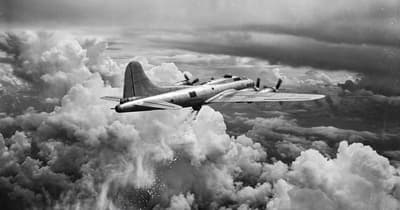
The men in the B-17 did not fly into the hurricane's eye. That would have been too much, even for 1947. Instead, they stayed near the outer clouds and fed chunks of dry ice into a crusher, letting the white pieces spill out of the bomber's belly into the storm below.[1]
In 1947, Project Cirrus dropped crushed dry ice into Hurricane King to test whether a storm could be changed. When the hurricane later made a sharp turn and hit Georgia, the experiment became a public scandal.
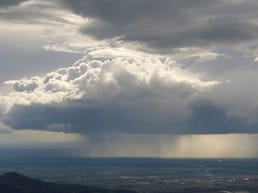
A year earlier, Vincent Schaefer had climbed into a plane near Schenectady, New York, and released dry ice into a cold cloud. Smithsonian describes him looking back and seeing streamers of snow falling from the cloud he had just seeded.[3] The idea was intoxicating because it made weather feel, for one bright moment, less like fate and more like equipment.
On October 13, 1947, Project Cirrus sent two B-17s and a B-29 from Mobile, Alabama, toward a hurricane east of Jacksonville. NOAA's history says the first bomber made a run more than 100 miles long and dropped about 80 pounds of dry ice, then returned for two larger drops of about 50 pounds each into a tall cloud top.[1] The crew saw clouds break up and grow. That was enough to make the flight home feel like evidence.
The next day, the scientists went looking for the storm where they expected it to be and did not find it. Hurricane King had moved nearly 100 miles west of the forecast position, made what NOAA describes as a 135 degree left turn, and strengthened. By October 15, it struck near Savannah, killing one person in the storm surge and causing about $2 million in damage in Georgia and South Carolina.[1]
Francis Reichelderfer, the chief of the Weather Bureau, had a problem no lab note could solve. Irving Langmuir of GE said he was 99 percent sure the seeding had changed the storm's course. Coastal residents heard a simpler version: scientists had touched a hurricane and the hurricane had come back.[1] Reichelderfer assigned Weather Bureau staff to find an unseeded hurricane that had made a similar turn. They did, and the threatened lawsuits faded.
By 1962, the same hope had a cleaner name and a bigger program. Project STORMFURY seeded hurricanes with silver iodide until 1983, still trying to make the storm build a weaker version of itself.[2] NOAA now says the flaw was hidden inside the clouds: hurricanes usually carried too much natural ice, too little supercooled water, and enough natural wobble to mimic a human victory.
The 1947 flight did not prove humans could steer a hurricane. It left behind a more uncomfortable picture: a bomber dropping 180 pounds of cold certainty into a system too large to notice, then people on shore trying to decide whether coincidence had an address. The dry ice vanished into cloud. The suspicion stayed on the ground.