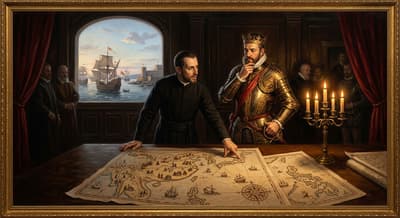
In 1586, a Jesuit priest named Alonzo Sánchez sat in Manila and wrote what might be the most audacious battle plan in colonial history. His target: Ming dynasty China, population roughly 150 million. His proposed invasion force: about 10,000 Spanish soldiers, thousands of Filipino warriors, and Japanese samurai recruited from Nagasaki. His secret weapons: Jesuit missionaries already inside the country, 200,000 pesos earmarked for bribing Chinese officials, and the sincere belief that God was on his side.[1]
This was not a daydream. It was an official government project called the Empresa de China, the "China Enterprise," and it had the backing of Philip II of Spain, the most powerful monarch on Earth.[1]
The idea went back decades. In 1526, Hernán Cortés wrote to King Charles V suggesting they conquer China from their new Pacific ports in Mexico.[2] The logic was intoxicating: if a handful of Spaniards could topple the Aztecs and the Incas with local allies, why not repeat the trick in Asia? Spain colonized the Philippines in the 1560s, and missionaries who visited the mainland came back reporting that China's population was enormous but "not warlike" and that the people resented their own officials.[1][2]
Sánchez turned that intelligence into a plan. He had visited China twice in the early 1580s and been arrested on his second trip. He returned to Manila convinced that only force would open China to Christianity.[3] His allies in the Manila Synod invoked Francisco de Vitoria's just war theories to argue the invasion was legally justified. Meanwhile, the head of the Jesuit mission in Japan, Francisco Cabral, volunteered two of his colleagues as spies: Matteo Ricci and Michele Ruggieri, already living inside China.[1][4]
By 1586, Sánchez had written the whole thing up. The invasion would launch from the Philippines in two prongs. Jesuits would serve as guides, translators, and intelligence assets. After the conquest, the plan called for mass conversion, the founding of colonial estates, hospitals, universities, and a state-sponsored program of intermarriage between Spaniards and Chinese women to build a new mixed population that would then conquer the rest of Asia.[1][5]
In 1587, it nearly became real. Fortifications went up in Manila. Weapons stockpiled. A Japanese fleet arrived from Hirado under the command of Konishi Yukinaga, a Christian admiral, offering soldiers for a joint invasion.[5] Sánchez sailed to Spain, got a personal audience with Philip II, and in March 1588 the king authorized an official planning committee.[6]
Five months later, the Spanish Armada was destroyed in the English Channel.[6]
That disaster, combined with furious opposition from Dominican and Franciscan monks who argued the invasion would endanger their own missionary work, killed the project for good.[6] The Jesuits' own leadership turned against Sánchez: Superior General Claudio Acquaviva assigned the theologian José de Acosta to write a formal rebuttal using the same just war theories Sánchez had invoked, this time to argue the invasion was unjustified.[7]
The Empresa de China quietly faded. Spain kept the Philippines. China kept being China. And one of the most detailed, ambitious military plans in history became a footnote most people have never heard of.[1]