Rayner Unwin gave away the ending, thought the book could do without pictures, and recommended it to children younger than himself. His report on The Hobbit, dated October 30, 1936, fills a single handwritten page. He was ten years old. His father paid him a shilling for the job.[2][5]
Stanley Unwin ran the publishing firm George Allen & Unwin and believed children were the best judges of children's books. Rayner earned a shilling for each written report. When J.R.R. Tolkien's manuscript arrived, Stanley gave it to his son to read. The boy's favorable verdict helped persuade his father to publish it.[1][5]
In his account of Tolkien's manuscript, Rayner moved quickly from Bilbo's home to his adventures. Gandalf and the dwarves persuaded the hobbit to leave. There were goblins and wargs, a mountain, a dragon, then a battle. Bilbo returned home rich. The boy put an exclamation mark after that last word. He had fitted the dragon's death and the return journey into his summary before offering an opinion on the book.[2]
At the bottom of the page, Rayner turned from the plot to his recommendation. With the help of maps, he wrote, the book did not need illustrations. He thought it would appeal to children aged five to nine. His verdict, tucked into the same sentence as his advice about pictures, was just three words: "it is good".[2]
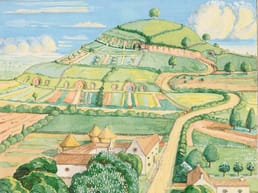
Tolkien's drawings and paintings won the publisher over, even though the book had not originally been intended for illustration. According to the Tolkien Estate, the pictures were added after the publisher saw them. Allen & Unwin published The Hobbit in September 1937. Readers got the adventure Rayner had enjoyed, along with illustrations he had considered unnecessary.[1][3]
After Rayner joined the family firm in 1951, he recommended another Tolkien manuscript to his father. This time it was The Lord of the Rings, and the sums were considerably larger. According to his Guardian obituary, he cabled his father that the book deserved publication but might lose a thousand pounds. Stanley replied: "If you believe it is a work of genius, then you may lose a thousand pounds."[4]
On the page Rayner wrote in 1936, there is no forecast of sales and no calculation of printing costs. He filled most of the space with Bilbo's travels. Near the bottom, he named the readers he thought should get the book: children between five and nine. Beneath that assessment of what younger children might like, he signed his name.[2]
Sources
- Rayner Unwin: biographical context
- Rayner Unwin's original reading report, October 30, 1936
- The Tolkien Estate: illustrations for The Hobbit
- Anthony Smith: Rayner Unwin obituary, The Guardian
- HarperCollins Publishers: The Hobbit
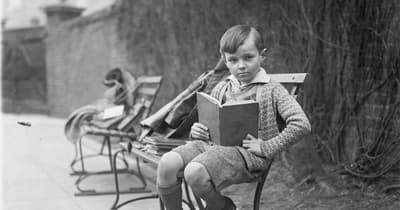
Hero image: an unidentified boy holding a book, probably Washington, D.C., circa 1920. Illustrative photograph, not Rayner Unwin. National Photo Company Collection / Library of Congress, LC-USZ62-111126. Public domain; cropped. Image source.