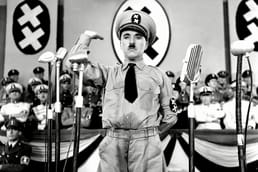
The joke was sitting in the title before anyone got slapped. In January 1940, Columbia released a Three Stooges short called You Nazty Spy!, a mangled phrase with a dangerous target: Adolf Hitler, ridiculed on an American screen before Charlie Chaplin's The Great Dictator reached theaters later that year.[1]
The Three Stooges were Jewish performers whose comic language often drew on Yiddish, and their 1940 short You Nazty Spy! is widely cited as Hollywood's first direct Hitler satire, released nine months before Chaplin's The Great Dictator.
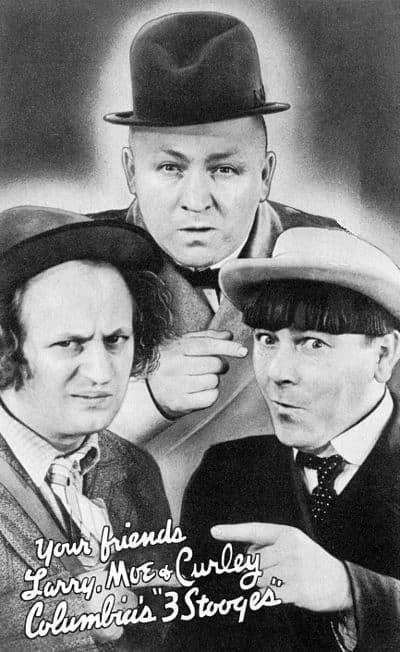
By then, the Stooges were already famous for a different sort of violence. Moe Howard's bowl cut, Larry Fine's frizzed hair, Curly Howard's shaved head, the eye pokes, the head bonks, the collapsing furniture, all made them look like men who had wandered into adulthood without learning how rooms worked.[1] Columbia Pictures eventually released 190 of their short subjects, a run of cheap workplaces, broken tools, bad manners, and bodies used like percussion instruments.[1]
The names under the act told another story. Moe Howard was born Moses Horwitz. Shemp Howard was Samuel Horwitz. Curly Howard was Jerome Horwitz. Larry Fine was Louis Feinberg, born in Philadelphia to a Russian Jewish family whose watch repair and jewelry shop supplied one of the stranger accidents of his childhood.[1][3] A bottle of hydrochloric acid, used to test gold, splashed onto young Larry's forearm after his father knocked it away from his mouth. Violin lessons, meant to strengthen the damaged muscles, helped make him a performer before he became the man in the middle of the Stooges.[3]
A Language Hidden in the Noise
The Stooges came out of vaudeville, where recognition had to be instant. A haircut could become a character. A shove could become a sentence. A strange word, barked at the right speed, could get a laugh before the audience had time to translate it.[1][5]
Many viewers heard the Stooges' verbal eruptions as gibberish, another layer of comic chaos between the slaps and falls. The act often folded in Yiddish words and Jewish-inflected rhythms, turning immigrant language into part of mainstream American slapstick.[1] The joke worked in two directions. Some people heard nonsense. Others heard something from home, tucked inside a Columbia short between a frying pan and a pratfall.
The lineup kept changing, even while the number stayed three. Moe and Larry were the constants. Shemp left, Curly entered, Curly's health failed, Shemp returned, and later Joe Besser and Curly Joe DeRita took the third spot.[1][2] The act lasted, in one form or another, from 1922 to 1970, longer than many of the studios, bosses, and theaters that shaped it.[1]
The Hitler Short Before Chaplin
You Nazty Spy! arrived in 1940, before Chaplin's more famous The Great Dictator reached audiences.[1] The timing still has a jolt to it. The Stooges were not known as solemn political artists. They were the men who wrecked plumbing, mangled courtrooms, and turned barbering into assault. Yet they put Hitler in the path of ridicule before Hollywood's most celebrated clown did.
Their satire used the tools already in their hands: parody names, fractured language, frantic authority, and the sight of puffed-up men made ridiculous.[1] For Jewish comedians in 1940, that ridicule carried a harder edge than ordinary farce. The Stooges' comedy had always been about bodies under pressure. In You Nazty Spy!, the pressure came from outside the soundstage.
Television later flattened the context. Beginning in 1958, the Columbia shorts aired regularly on TV, where new generations met the Stooges as after-school chaos, separated from vaudeville, studio contracts, Jewish immigrant speech, and wartime satire.[1] A kid could laugh at the eye poke without knowing that the same team had once turned Yiddish-laced nonsense and slapstick contempt toward Hitler.
The punch lands first. The meaning shows up later, wearing a bowl cut, holding a violin, and answering to a name changed for the stage.