When the United States passed 100,000 COVID-19 deaths, journalists reached for comparisons big enough to hold the loss. Twice the number of Americans killed in the Vietnam War. More than U.S. military combat fatalities in every conflict since the Korean War. The comparisons were an attempt to make a number behave like a human fact.[1]
Psychic numbing is the psychological phenomenon in which larger death tolls can produce weaker emotional responses. One identifiable life can move us deeply, while hundreds, thousands, or millions of lives may blur into statistics.
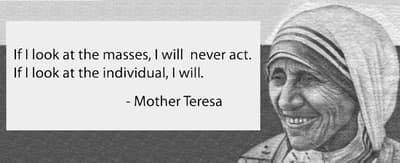
Mother Teresa put the problem in one sentence: “If I look at the mass I will never act. If I look at the one, I will.”[2] Paul Slovic, a psychologist at the University of Oregon, used that line as the title of his paper on psychic numbing and genocide, because it names a failure that can appear in otherwise caring people.[2]
In Slovic’s paper, the puzzle begins with a generous assumption. Most people will make great efforts to rescue an individual victim whose need comes clearly into view. The difficulty begins when that person becomes “one of many” inside a much larger disaster.[2] The mind does not add one unit of grief for every additional life. Feeling does not scale like arithmetic.
Slovic described the flaw to BBC Future in plain terms. Our fast, intuitive gut feeling is powerful, he said, but it “doesn’t deal with numbers in magnitude very well.” One life can feel tremendously important. As the numbers rise, our feelings do not rise in the same proportion.[1]
The result can be more unsettling than ordinary indifference. Slovic’s research suggests that as the statistical size of a tragedy grows, people may become desensitized, and compassion can fade or collapse rather than expand.[1] A death toll of one invites a face, a name, a rescue. A death toll of 400,000 asks the imagination to do work it is poorly built to do.
The Problem With Large Numbers
During the pandemic, BBC Future noted evidence of coronavirus news fatigue as people read less about the crisis, even while the global death toll had passed 400,000 and more than seven million cases had been recorded in 200 countries.[1] Each death belonged to a family left shocked and bereaved. From far away, those deaths arrived as updates, graphs, milestones, and rounded figures.
Slovic’s 2007 paper describes mass-death statistics as “human beings with the tears dried off.”[4] The phrase is brutal because it is precise. A number can be accurate and still fail to carry the emotional information that moves people to act. It can report the scale of suffering while removing the particular person who suffered.
That weakness matters beyond one pandemic. Slovic connected psychic numbing to the recurring failure of nations and publics to respond effectively to mass murder and genocide. Every atrocity has its own politics and obstacles, he wrote, but repeated neglect points to a deeper limitation in how human feeling responds to large-scale suffering.[2]
Compassion often needs a doorway small enough to enter. A photograph, a name, a single child, a single family, a story that can be held in the mind. Without that doorway, enormous loss can become abstract. The count keeps climbing, but the heart has stopped counting with it.
One death can move us. Ten thousand deaths may not move us ten thousand times more. Somewhere between the face and the figure, the tears dry off, and a life becomes a line in a table.
Sources
- BBC Future, “What makes people stop caring?”
- Paul Slovic, “If I look at the mass I will never act”: Psychic numbing and genocide
- Australian Psychological Society, “Genocide: Is it that the more who die, the less we care?”
- Judgment and Decision Making, “Psychic numbing and genocide” full text
- Goodreads, Mother Teresa quote listing