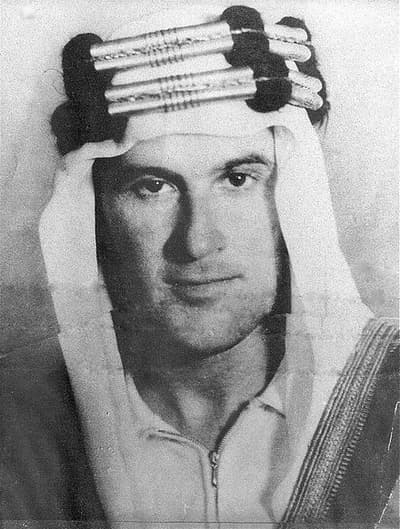
Most people spend their lives trying not to betray the world that made them. Poncke Princen did it twice. First he fought the Nazis. Then he turned on the Dutch army that sent him to crush Indonesian independence. Later, he helped expose mass killing under one of Indonesia's own dictators. At each stage, he crossed a line respectable society insisted should not be crossed. And at each stage, he seems to have crossed it for the same reason: once he decided a system was morally rotten, loyalty to it no longer counted as virtue.[1]
That is what makes Princen so hard to fit into a national story. The Dutch could not easily celebrate him, because he deserted their colonial war. Indonesians did not always know what to do with him either, because he was, after all, a Dutchman who had arrived in uniform. Yet by the end of his life he had become something rarer than a war hero or a dissident. He became a man whose biography kept forcing the same uncomfortable question. What do you owe your country when your country is doing something indefensible?
The Making of a Defector
Johannes Cornelis Princen, better known as Poncke Princen, was born on November 21, 1925, in The Hague.[1] He grew up in a household shaped by freethinking, anticlericalism, and anarchist leanings. Even in family memory, authority was not something to obey automatically. One ancestor had been a military deserter. That mattered. So did the times in which Princen came of age.
During World War II, he joined the Dutch resistance against the Nazis.[1] This is the first thing to understand about him. He was not a man who drifted passively into history. He had already chosen a side once before, and it was the side of people resisting occupation. The trouble came later, when the Netherlands asked him to put on a uniform in a different war and pretend that this occupation was something else.
After the war, Princen was sent as a Dutch soldier to what was still called the Dutch East Indies, where the Netherlands was trying to reimpose colonial rule after Indonesia had declared independence in 1945.[1] Officially, this was framed as restoration, order, sovereignty, duty. Colonial powers are always rich in euphemisms. On the ground, it was a war against people trying to stop being colonized.
The Moment the Story Broke
Some lives turn on ideology, others on observation. Princen's seems to have turned on seeing too much. In Indonesia, he witnessed Dutch war crimes and became increasingly unwilling to serve the cause he had been sent to defend.[1] For someone who had fought the Nazis, the moral pattern must have been impossible to miss. He had resisted one occupying force in Europe only to find himself serving another in Asia.
So in 1948 he deserted.[1] That word makes the act sound smaller than it was. He did not simply run from service. He crossed over and joined the Indonesian pro-independence guerrillas.[1] In the Dutch imagination, that made him a traitor. In Indonesian history, it made him something stranger still: a colonial soldier who had concluded that the colonized were right.
Defection is often treated as an ideological abstraction. In reality, it is intimate. It means accepting that the people you ate with, marched with, obeyed, and perhaps feared will now regard you as the enemy. It means burning your way back. Princen did exactly that.
A Dutchman in an Indonesian Revolution
Once he joined the guerrillas, Princen's life stopped making sense within the ordinary categories of empire. He was Dutch, but fighting Dutch troops. European, but on the side of an anticolonial revolution. A former soldier of a colonial state now trying to help dismantle it. That is one reason his story remains so arresting. It disrupts the lazy assumption that people are always most loyal to the flags they were born under.
After Indonesian independence, he stayed.[1] He did not return to the Netherlands to rehabilitate himself or explain away what he had done. He built the rest of his life in Indonesia, eventually becoming an Indonesian citizen and a prominent human rights activist.[1] He also converted to Islam, another crossing-over that made his earlier national identity seem even less useful as a guide to who he had become.[1]
But staying in Indonesia did not mean becoming obedient to Indonesian power. That is the second remarkable thing about him. Many revolutionaries are brave while fighting empires and timid once the new state takes power. Princen was not interested in making that transition.
From Revolutionary to Dissident
Indonesia's post-independence history did not deliver clean freedom. It delivered, among other things, authoritarian rule, detention, repression, and the violent consolidation of power under successive regimes. Princen became a human rights advocate and political dissident under those governments as well, and because of that he spent substantial time in detention.[1]
That arc matters. It would have been easy, and emotionally satisfying, for his life to resolve into a simple fable: Dutch anti-fascist fights colonialism, joins the right side, and lives happily ever after in the new nation. Real history is meaner than that. The country whose independence he supported went on to produce its own machinery of repression, and Princen, maddeningly consistent by then, opposed that too.
Which brings us to perhaps the most morally difficult chapter. Under Suharto, Indonesia saw anticommunist massacres on a staggering scale. Princen later helped expose those killings.[1] This is where his life stops looking like a sequence of dramatic reversals and starts looking like one long argument. He was not loyal to nations. He was loyal to the proposition that states do monstrous things when nobody insists on saying so out loud.
The Trouble with Men Like This
Countries do not quite know how to remember people like Poncke Princen. He embarrasses too many official myths at once. For Dutch colonial memory, he was the soldier who looked at empire and chose the other side. For any easy triumphalist version of Indonesian nationalism, he was the reminder that independence did not end the moral work. For authoritarians of every kind, he was the deeply inconvenient sort of person who keeps recognizing the pattern.
He died in Jakarta on February 2, 2002.[1] By then he had spent more than half a century in the country he had once entered as an occupier in uniform. That alone would make his biography memorable. But what lingers is not just the drama of defection. It is the consistency underneath it.
Princen fought the Nazis because he opposed occupation. He deserted the Dutch army because he opposed colonial violence. He challenged Indonesian dictatorship because he opposed repression. The uniforms changed. The flags changed. The language of justification changed. His reaction, more often than not, did not.
There is something almost unnerving about a life that coherent. Most people adapt themselves to the moral vocabulary of the institutions around them. Poncke Princen kept doing the opposite. He took institutions at their word, looked at what they actually did, and when the distance between the two became too large, he walked away, even if that meant becoming a traitor in someone else's history book.