Before going near the chicks, the adults covered themselves in white smocks, hoods and goggles. They were forbidden to talk around the birds. Even a name was too much: each hatchling got a number, a small precaution against someone deciding it was a pet. The people doing the feeding were trying very hard to go unrecognized.[1]
Bill Lishman and Joe Duff founded Operation Migration in 1994, developing a way to lead birds along migration routes with ultralight aircraft. Their work expanded to endangered whooping cranes in 2001.[3][2] A young crane ordinarily learns the journey by following older birds. A captive-raised chick has no experienced parent ready to take it south. Someone would have to become convincing enough to follow, without teaching the bird to seek out people.[1]
While the chicks were still inside their eggs, recordings of an ultralight engine introduced the sound of their future escort. After hatching, they encountered people disguised in white, with hand puppets resembling adult cranes. A chick could grow accustomed to the engine without learning to approach an undisguised person. Its caretakers had to make that distinction for it.[1]
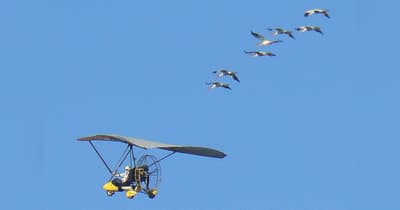
At eight weeks old, the young cranes followed the aircraft as it taxied along the ground. By 80 to 90 days, they were flying with it. An ultralight gave the pilot a way to keep pace with the birds; a loudspeaker attached to its landing gear played a crane brood call to encourage the flock to stay in formation. Once airborne, the cranes jostled for a place in the wingtip vortex, where flying took less effort.[1]
On the journey from Wisconsin to Florida, the flock had roughly 1,200 miles to learn. In 2005, a dozen people worked on the migration, including two flying Cessnas to coordinate with air traffic control and the ground crew. Weather and the birds dictated how far a flight leg went. The Smithsonian records stretches as short as 23 miles and as long as 200. The costumed pilot could take the birds only as far as that day allowed. The rest of the team had to keep up.[1]
Over 15 years, Operation Migration pilots led 186 whooping cranes south. The Wisconsin Society for Ornithology reports that the survivors returned north the following spring and continued migrating annually.[2] In spring, the cranes could take off for Wisconsin without a pilot in front of them. The team had spent months becoming familiar enough to follow; now the birds could leave.
When the aircraft-led program ended, the unresolved problem was raising the next generation. According to the Wisconsin Society for Ornithology, the U.S. Fish and Wildlife Service questioned whether raising chicks with costumed handlers left them poorly prepared to protect their own offspring. Operation Migration disagreed with the change in approach; when it announced its dissolution in 2018, other conservation partners still believed a self-sustaining eastern flock was achievable. The birds had learned the route, but the project still depended on their being able to raise chicks along it.[2]
The hood and goggles eventually entered the Smithsonian collection, along with an ultralight and other equipment.[1] The cranes that learned the route had already been making the trip back to Wisconsin with no one inside a costume to follow.[2]
Sources
- National Air and Space Museum: Operation Migration
- Wisconsin Society for Ornithology: Operation Migration Calls It Quits
- Wikipedia: Operation Migration (background)
Hero photograph: Tim Ross, public domain. Young cranes following an Operation Migration ultralight, January 17, 2009. Cropped with soft sky extensions.