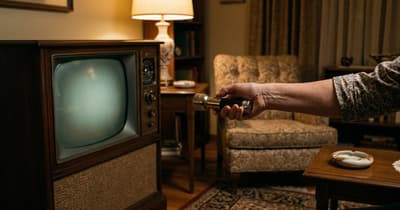
In 1955, Zenith asked television owners to point a little light gun at the family set and fire at whatever annoyed them. Not at the picture tube in anger. At commercials. The company's Flash-Matic remote looked enough like a toy pistol that the sales pitch leaned into the gesture: if an announcer got on your nerves, you could shoot the sound away and keep watching the screen for the moment the program returned.[4]
The Zenith Flash-Matic, introduced in 1955, was the first wireless television remote control. Its oddest selling point was not laziness, but control: viewers could aim a handheld light device at the set and mute commercials without leaving the chair.
Eugene Polley, a Zenith engineer who had joined the company in 1935, built the device around visible light. BBC's obituary of Polley describes the Flash-Matic as a beam aimed at photo cells placed at the corners of the television cabinet, where it could turn the set on or off and change channels.[1] The Early Television Foundation's museum page puts the same trick in plainer living-room terms: the handheld unit was essentially a flashlight with a momentary switch, aimed at the volume knob or channel selector.[2]
The complaint it answered was not hard to understand if you picture a 1950s floor between the chair and the television. Zenith's earlier Lazy Bones remote, listed in the company's own heritage timeline in 1950, was wired to the set.[3] That solved the walk across the room and introduced a new nuisance: a cable stretched through domestic life. Flash-Matic cut the cord by turning the room itself into part of the control system.
The room was also the problem. Sunlight, lamps, and other stray brightness could fool the photo cells, which is why the Early Television Foundation notes that the system did not work well.[2] A person might be trying to command a machine from an armchair, only to discover that the window had opinions too. Zenith followed in 1956 with Space Command, the more practical wireless remote that used ultrasonic sound rather than visible light.[3]
The commercial still kept playing on the screen. Television had already changed the room by asking people to sit still while a broadcaster decided what came next. Then advertising arrived inside that flow, loud and unavoidable. The mute function gave viewers a small private answer. You could not remove the commercial from the broadcast, but you could remove it from your house for thirty seconds.
The pistol shape made that answer theatrical. The viewer did not just press a button. The viewer aimed. The old ads turned a household annoyance into a tiny showdown between the chair and the screen.[4] That gesture is still with us, softened into plastic rectangles, streaming skips, mute icons, and thumbs hovering over phones. The technology improved because the first version was fragile. The desire behind it needed no improvement at all.
The Flash-Matic survives as a strange ancestor of the most ordinary object in the living room. A beam of light, a stubborn commercial, a television waiting for a signal from across the carpet: the future of watching TV began with someone pretending to shoot the noise.