In Mauch Chunk, Pennsylvania, people climbed into cars on a railroad that had not been built for fun. The track had carried coal down from the mines by gravity; later, tourists rode the same basic idea, dropping along miles of rail at speeds that could feel outrageous in a world before automobiles.[1][3]
The American roller coaster was popularized in 1884 by LaMarcus Adna Thompson, a devout hosiery entrepreneur who hoped his Coney Island ride would pull people toward wholesome amusement and away from saloons, brothels, gambling, dancing halls, and other temptations.
Thompson’s first fortune came from stockings, not spectacle. He worked in Elkhart, Indiana, and made money from hosiery, including a seamless stocking machine.[3] By the late 19th century, he had become troubled by the amusements gathering around American cities. Smithsonian describes him as disgusted by “hedonistic amusements like saloons and brothels,” and later accounts add taverns, gambling, and dance halls to the list of diversions he wanted to compete against.[1][2]
His answer was a piece of machinery. The Mauch Chunk Switchback Railway had shown that a device built for industry could be repurposed as pleasure. Built in 1827 to haul coal roughly nine miles, the railway sent loaded cars downhill by gravity and brought empty cars back up by mule.[1] When it became a tourist attraction, the run could reach about 50 to 65 miles per hour, a startling speed for riders who had few chances to move that fast.[1][3]
A Five-Cent Alternative to Vice
In 1884, Thompson opened the Switchback Gravity Railway at Coney Island in Brooklyn.[1] A ticket cost five cents.[1] The cars were slow by modern standards, moving at less than six miles per hour, and passengers sat facing outward instead of forward.[1]
That sideways posture says a great deal about the original purpose of the ride. Thompson was not yet trying to create the modern scream machine. He wanted passengers to look at constructed scenery as they rolled along. His scenic railways included landscapes made to resemble places such as the Swiss Alps and Venetian canals.[1]
For a reform-minded businessman, the ride offered a useful bargain. It gave respectable visitors novelty, motion, and scenery without sending them into the saloon, the gambling room, the dance hall, or the brothel.[1][2] The thrill was present, but it was wrapped in a moral package: clean entertainment, sold by the nickel, on a track by the sea.
Thompson is often called the “Father of the American Rollercoaster” because his Coney Island ride helped link coasters with amusement parks in the United States.[1] The title needs a little care. Roller coaster-like entertainments had earlier roots, and the Mauch Chunk railway was carrying pleasure riders before Thompson’s Coney Island attraction.[1][3] What Thompson helped create was the American amusement-park version: a manufactured experience built for paying crowds.
From Scenery to Loops
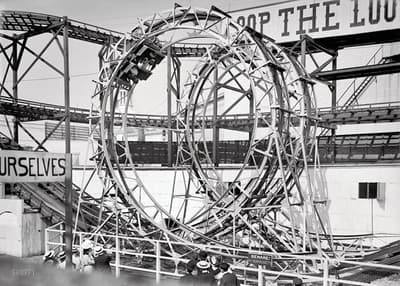
By the end of the century, designers were already pushing the form beyond Thompson’s gentle moral theater. On August 16, 1898, Massachusetts designer Edwin Prescott received a patent for an improvement to looping roller coasters.[1] His Loop the Loop at Coney Island was not the first coaster to invert riders, but it helped introduce the safer, more comfortable elliptical loop that later became standard.[1]
Prescott’s ride also showed the limits of novelty. Only one car with four passengers could run at a time, so the coaster could not move crowds efficiently. It closed in 1910 after nine years.[1]
The path from Thompson’s scenic railway to Prescott’s loop is a short one: coal-hauling gravity, then moral recreation, then engineered danger. The American roller coaster began as a respectable place to send restless people, and it kept the old bargain in altered form. A person still climbs into a car, surrenders to gravity, and is carried somewhere other than the street outside.