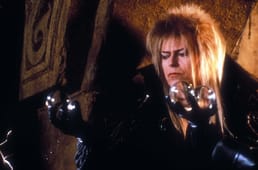
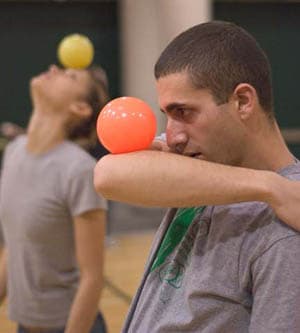
On the Labyrinth set, the hands doing the crystal-ball magic were hidden. Michael Moschen stood behind David Bowie, reached around him, and performed the manipulation blind, so the camera could see Bowie’s character commanding the sphere while the actual juggler stayed out of sight.[1]
The crystal-ball juggling in Labyrinth was performed by Michael Moschen, not David Bowie. Moschen did the contact-juggling work from behind Bowie, and in 1990 he was named a MacArthur Fellow for his originality as a performance artist.
In the film’s credits, Moschen receives the plain little phrase “crystal ball manipulation,” which undersells the assignment. The ball seems to hover over Bowie’s hands, slide across his fingers, and move with the calm obedience of a trained animal. The trick is that the visible performer and the working performer are two different people.[1]
The form is usually called contact juggling, or contact manipulation. Unlike toss juggling, it does not depend on objects leaving the hand and returning. The ball stays in contact with the body, rolling across palms, arms, shoulders, or fingers while the performer hides the labor inside smooth motion.[1]
Those movements had a life before the Goblin King. Balancing and rolling a single ball, and palm-spinning related to traditions such as Baoding balls, had been performed for centuries. Vaudeville performers, including Paul Cinquevalli, added variations, and in 1986 the American juggler Tony Duncan was reported to be holding audiences spellbound with an act built around rolling one ball over his body.[1]
The Performer Behind Bowie’s Hands
Moschen pushed the art toward a colder, glassier kind of illusion. In the 1980s he developed a performance called “Light,” using 75-millimeter clear crystal balls. He could palm-spin as many as eight balls at once, then finish by rolling a single clear ball so it appeared to float over his hands and arms.[1]
Labyrinth used that same visual language. Bowie’s character needed to look casually supernatural, as if a crystal sphere could idle in his fingers like a coin or a cigarette. Moschen supplied the mechanics from a place no performer would choose for comfort: behind the star, reaching around him, without the normal sightline to his own hands.[1]
A contact-juggling illusion depends on small corrections that the audience is not meant to notice. A ball that looks still is being managed. A roll that looks frictionless is a sequence of touch, angle, and timing. Put the juggler behind another body, and the job becomes stranger than a movie effect. It is stagecraft performed through borrowed arms.
After the Crystal Ball
In 1990, four years after Labyrinth, Moschen was made a MacArthur Fellow, the award often nicknamed the “Genius Grant.” The MacArthur Fellows Program recognizes people working in many fields who have shown “extraordinary originality and dedication” in creative pursuits, along with a marked capacity for self-direction.[2] The contact-juggling article notes that Moschen received praise from the international circus community for his innovative techniques before receiving the fellowship.[1]
That same year, the art was also becoming easier to name and teach. John P. Miller, later better known by the pen name James Ernest, wrote and published the first edition of Contact Juggling in the summer of 1990. The book covered basic contact-manipulation techniques and methods for learning them, and its first edition ran to only 100 photocopied, stapled copies.[1]
So the famous Labyrinth image carries more than a bit of movie trivia. It holds an older hand skill, a vaudeville inheritance, a 1980s performance experiment, and one very awkward filming arrangement. On screen, the crystal belongs to Bowie. Just outside the frame, it belongs to Moschen, making glass drift through someone else’s hands.