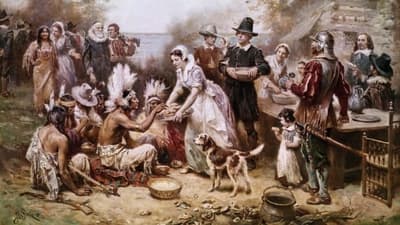
On the Mayflower, the famous religious refugees were outnumbered. Of the 102 passengers who crossed in 1620, only about thirty-five belonged to the Separatist congregation from Leiden. The rest were merchants, craftsmen, laborers, and other settlers the Separatists called “the Strangers.”[1]
The Pilgrims did flee religious pressure, but not because England was Catholic or hostile to Protestantism itself. They were radical English Protestants, Separatists with Puritan beliefs, who thought the Church of England remained too compromised and wanted a stricter, independent religious community.
England in their lifetime was already Protestant. The Reformation had split western Christianity into Catholic and Protestant churches, and the Church of England had broken from Rome generations earlier.[2] The fight that shaped the Pilgrims was more intimate and more combustible: Protestants arguing with other Protestants over how completely the English church should be remade.
Some English reformers believed the national church still carried too much old Catholic structure, ceremony, and hierarchy. Puritans wanted to purify the Church of England from within, pressing it toward stricter biblical teaching, moral discipline, and Calvinist theology.[3] The people later remembered as the Pilgrims went further. They were Separatists, sometimes called Brownists, who believed the church could not be repaired at all. True believers, they argued, had to gather in independent congregations outside it.[1]
That was not treated as a harmless preference about Sunday worship. In Tudor and Stuart England, church and state were tied together, and rejecting the monarch’s authority over the church could look like rejecting the political order itself.[4] The Conversation describes England’s most radical Puritans as “enemies of the state,” people caught between silence, exile, and punishment under treason law.[4]
Their complaint can sound inverted to modern ears. They were not mainly asking for a broad public tolerance in which every conscience could flourish. They condemned the established church for being too broad, too compromised, and insufficiently reformed. Some denounced it as false, attacked bishops in fierce language, and used the relative freedom of the Netherlands to print and circulate illicit religious texts.[4]
Before Plymouth, Leiden
Before there was Plymouth, there was Leiden. The core Separatist congregation had already fled England for the Netherlands, where religious dissenters found more room to organize, worship, and publish.[1] After years in Dutch exile, they decided to establish a settlement across the Atlantic and arranged financial backing for the voyage.[1]
The Mayflower, then, was not a single leap from English persecution to American freedom. For the Separatist minority aboard, it was a second migration: from England to Holland, then from Holland toward a colony where their church might survive on its own terms.[1]
The passenger list shows how practical the project had to be. The Leiden Separatists could not fill or fund the venture alone, so they sailed with people who had other reasons to go. Before landing, the passengers signed the Mayflower Compact, a civil agreement meant to hold Saints and Strangers together in one fragile settlement.[1]
A Smaller, Stricter Refuge
The Pilgrims belonged to a wider seventeenth-century Atlantic pattern. The Library of Congress describes many British North American colonies as settlements founded by men and women who refused to compromise deeply held religious convictions, while noting that some migrants also came for secular reasons such as fishing and trade.[5]
Larger Puritan migration came later. Beginning in 1630, thousands went to Massachusetts Bay, hoping to build a “godly commonwealth” and a model Christian society.[3] Plymouth was smaller and earlier, and its leaders were more openly separatist, but both movements grew from the same argument over what a purified church should look like.
The familiar story still contains a real persecution story. It just leaves out the harder edge of the belief that made the Pilgrims dangerous at home. On the Mayflower, that conviction shared space with barrels, tools, investors’ hopes, hired hands, and Strangers, all crossing toward a settlement built by people trying to get farther from a church they thought had not been purified enough.