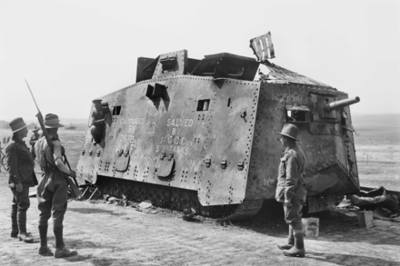
On the front of the German tank, someone had painted a red demon sprinting away with a piece of a British tank tucked under its arm. The joke came from a Persil laundry detergent advertisement, but the name above it came from older, darker stock: Mephisto, the demon of German folklore.[1]
Mephisto is the only surviving German A7V tank from World War I. It was abandoned during the fighting at Villers-Bretonneux in 1918, recovered by Allied troops months later, and eventually shipped to Brisbane as a war trophy.
The machine started its army life as vehicle number 506. It was issued to the German army in late December 1917 or early January 1918, then sent into action on March 21 with four other A7Vs and five captured British tanks at Curgies, north-east of Saint-Quentin.[1] After minor repairs and repainting at a German tank workshop near Charleroi, it returned to service in mid-April under Lieutenant Heinz Theunissen.[1]
By then, German crews had taken to naming A7Vs after figures from German history or mythology.[1] Theunissen is believed to have chosen Mephisto, a shortened form associated with Mephistopheles, the devilish figure from the Faust legend and German folklore.[1][2] The name was painted on the front and rear armour, giving the heavy fighting vehicle the personality of a prankster demon.
The tank left in the shell-hole
In April 1918, German high command planned an attack on Villers-Bretonneux, a Western Front town whose capture could help threaten Amiens, about 20 kilometres to the west.[1] After reconnaissance suggested the ground was suitable for tanks, fifteen A7Vs were allocated to the assault.[1]
Mephisto’s part in the attack ended in a shell-hole. During the German assault, the tank became stuck and its crew abandoned it.[1] The machine that had arrived with a demon painted on its armour was left in the broken ground near Villers-Bretonneux, too valuable to ignore and too immobile to save.
About three months later, Allied troops recovered it from the battlefield.[1] The museum word is recovery, but the object had already changed categories. It was no longer only an enemy weapon. It was a captured thing, a proof of survival, a machine that could be hauled away, displayed, and pointed at after the guns stopped.
A trophy for Brisbane
After the war, Mephisto was taken to Australia as a trophy.[1] That journey is part of what makes the tank so strange. Most battlefield machines vanish through damage, scrap, target practice, weather, or usefulness. Tanks are not built to become relics. They are built to be repaired until they cannot be repaired, stripped until they cannot be stripped, and replaced by newer metal.
The A7V itself was already a rarity. Germany built only a small number of them, and Mephisto is now the only surviving example.[1] Its survival depends on a chain of accidents and choices: a stuck tank, an abandoned crew, a delayed recovery, and a decision to send a German war machine across the world rather than melt it down or leave it to rust.
Today, Mephisto is housed at the Queensland Museum in Brisbane, in the Anzac Legacy Gallery.[1] It is no longer in mechanically running order.[1] The red demon remains part of the story, but the tank’s last act is stillness: armour, name, and trophy all fixed in place, far from the shell-hole where its war ended.